
Ukrainian Strikes and American Sanctions: Emptying the Tank of the Russian War Machine
The Mechanism:
Why Energy Was Always The Target
The American Ukraine Committee has released a new report, "Ukrainian Strikes and American Sanctions: Emptying the Tank of the Russian War Machine."
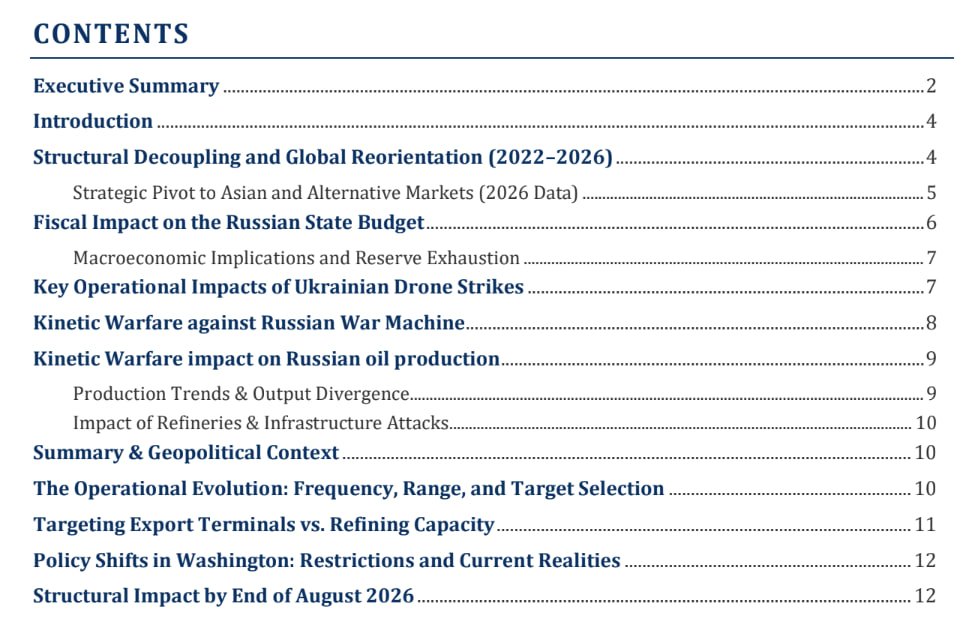
We prepared it as a reference for congressional offices working on Russia sanctions: a sourced, 15-page picture of what sanctions and Ukrainian strikes have actually done to the Kremlin's energy revenue through August 2026.
Below is a longer look at what the data shows, why it matters for the policy debate happening in Washington right now, and what needs to happen next.
For decades, Russia's federal budget has run on a simple mechanism: energy exports, historically accounting for roughly 30% of the federal budget and covering over 90% of the military and defense budget, functioned as an external subsidy for the war machine.
The late Senator John McCain's description of Russia as "a gas station masquerading as a country" was not a rhetorical flourish, it was a structural diagnosis. Before the full-scale invasion, Europe was Moscow's single largest customer, generating 50 to 55% of Russia's total oil and gas export revenue and absorbing 70 to 80% of its pipeline gas.
That is precisely why degrading the energy sector became the central axis of both Western sanctions policy and Ukraine's own long-range strike campaign. But for years, the two efforts ran on different tracks and, at times, worked against each other.
Sanctions Alone Weren't Enough
Multilateral sanctions (price caps, embargoes, and the closing of European pipeline markets) did real structural damage. By 2025 to 2026, the EU's dependence on Russian gas fell from roughly 45% to about 13%, and its reliance on Russian oil fell to 2 to 3%. The EU's share of Russia's total fossil fuel export revenue has stabilized at just 7.5 to 10%, down from being Russia's dominant market.
But Moscow adapted. It redirected exports to Asia: China now absorbs 50% of Russian crude exports and generates 41 to 43% of Russia's total fossil fuel revenue; India takes another 36 to 37%. A "shadow fleet" of aging, unflagged tankers was built specifically to route around Western sanctions and insurance restrictions.
The result: sanctions constrained Kremlin revenue, but on their own they did not crash the Russian economy or meaningfully curtail Russia's capacity to keep fighting.
The Second Track:
Ukraine's Strike Campaign
In response, Ukraine built a second line of pressure: a campaign of mid and long-range drone strikes on Russian oil refineries and export infrastructure, aimed not at export markets abroad but at Russia's ability to process what it pumps.
The campaign evolved through three distinct phases:
Phase I (2022 to mid-2023): Sparse, border-proximity strikes on fuel depots near the front line (Belgorod, Bryansk, occupied Crimea), using converted commercial drones and modified reconnaissance UAVs. The first strike on a major refinery, Novoshakhtinsk in Russia's Rostov region, came on June 22, 2022, but the campaign stayed limited: the Biden administration urged Kyiv to hold off, citing fears of a global oil price spike during a U.S. election cycle.
Phase II (late 2023 to 2025): With mass-produced long-range drones (Liutyi, Bober), Ukraine shifted from fuel depots to primary crude distillation units, high-value, Western-sanctioned-component-dependent infrastructure that takes months to repair when destroyed. Strikes reached 800 to 1,000 km into Russian territory, hitting major refineries at Ryazan, Kstovo, Kirishi, and the Tuapse export hub, averaging 15 to 20 successful strikes per quarter by mid-2025.
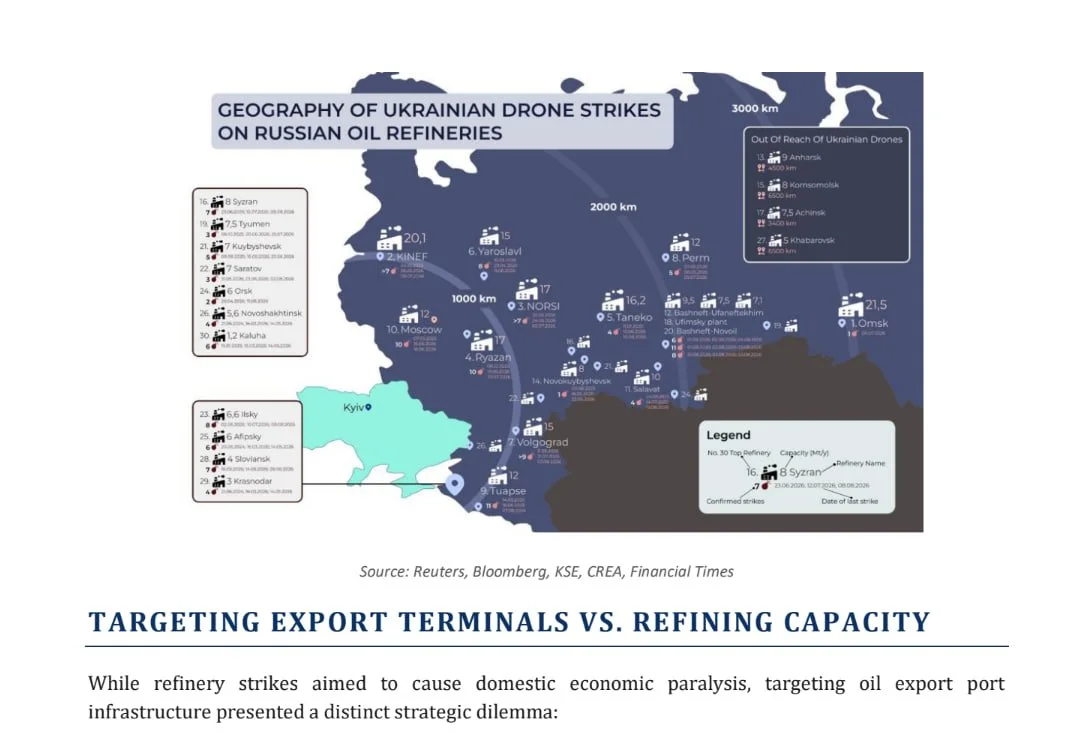
Phase III (2026): Strikes reached industrial frequency and depth. In the first half of 2026 alone, Ukraine executed at least 194 successful strikes, an 11-fold increase over the same period in 2025, with a geographic reach expanding to 1,600 km, deep into Bashkortostan, hitting the massive Ufa refining complex.
By late August 2026, Ukraine had damaged 24 of Russia's 34 major oil refineries, taking out roughly 5.1 million barrels per day of installed processing capacity and driving national refinery throughput down to 3.8 to 3.9 million b/d (the lowest level in 20 years, and more than 1.4 to 1.6 million b/d below 2025 levels).
Why This Matters For
The Sanctions Debate Right Now
This is the clearest evidence yet available that it is the combination of Ukrainian strikes and sanctions, not sanctions alone, that is actually straining Russia's capacity to fund the war. That distinction matters directly for the policy conversation happening in Congress today, because it shows that the leverage the U.S. has isn't just about closing loopholes on paper: enforcement, secondary sanctions, and tolerance for Ukraine's own operational latitude all compound each other's effect.
A Thank You to Congress
Against that backdrop, the sanctions bill that just passed Congress is the broadest sanctions legislation against Russia since the full-scale invasion.
President Zelensky called its passage "a very important historical moment."
What Comes Next
Passing the bill doesn't make it happen. The tariffs are authorized, not automatic, and waivers exist if the administration chooses to use them. How this law is implemented, not just how it was written, will determine whether it changes Russia's calculus. That leaves three things to do:
Thank your Representative if they supported the bill. This kind of vote needs to be reinforced, not taken for granted.
Monitor implementation closely. Watch whether the tariffs and secondary sanctions are actually enforced against the named importers and evaders, or quietly waived.
Keep pushing on what this bill does not do. It does not supply Ukraine with weapons or Patriot systems to protect civilians from Russian bombardment, and Russia's response to the bill's passage was, tragically, a massive bombardment of Ukrainian cities. The fight over enforcement and the fight over air defense are both still ahead of us.
Our dearest Ukraine Advocates,
As always, thank you for reading this far!
We're happy to answer questions or share the underlying data behind the report at any point. Write to us at info@amukr.org.
Every voice counts. Stay with us:
💬 Join our WhatsApp community
📩 Get updates from Capitol Hill
❤️ Help us keep the pressure on