
Can Mandatory Sanctions Move Russia Toward a Just Peace?
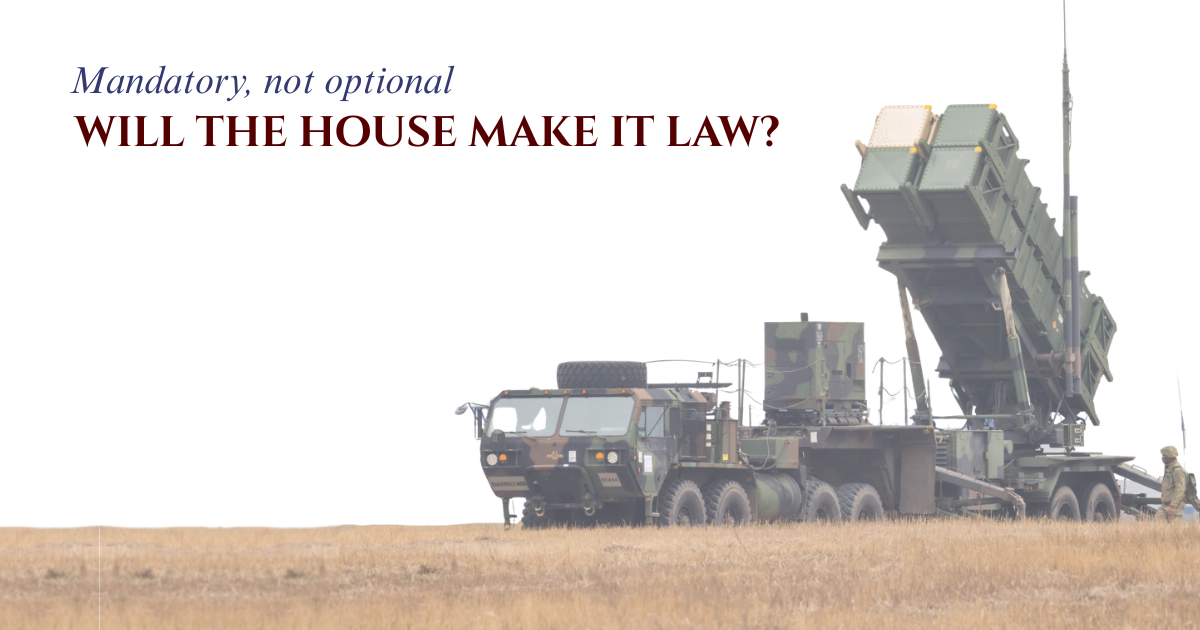
On August 7, 2026, the U.S. Senate passed the Lindsey O. Graham Sanctioning Russia and Iran Act of 2026 (S. 5025) by an overwhelming 86–11 vote — one of the widest bipartisan margins on any Ukraine-related measure this Congress. The bill now moves to the House of Representatives, where a companion measure, H.R. 2548, already carries strong bipartisan cosponsorship led by Ukraine Caucus co-chairs.
With the Senate's work done, one question defines the road ahead: Will the House finish the job? For supporters of Ukraine, this is not a debate about whether to pressure the Kremlin, it is a solvable, procedural step that can turn broad support into durable law.
What the Legislation Actually Does
The bill is built around a simple principle: economic pressure on Russia should be predictable, enforceable, and hard to unwind. Its core provisions:
Mandatory sanctions on Russian government officials, financial institutions, and entities tied to Russia's defense and energy sectors.
Restrictions on U.S. persons from investing in Russia, purchasing its sovereign debt, or exporting energy products to Russia.
Tariff authority allowing tariffs of up to 100% on the top five importers of Russian crude oil or natural gas, and on the top five facilitators of Russia's sanctions evasion.
Shadow fleet enforcement targeting the clandestine maritime networks Moscow uses to move oil around Western restrictions.
A conditional off-ramp: the measures can be lifted only if Russia signs and upholds a peace agreement accepted by Ukraine, subject to congressional review.
Extension of the Iran Sanctions Act of 1996 through 2031, preventing a lapse in long-standing authority over Iran's energy and weapons financing.
Predictable pressure is harder to game than discretionary pressure. When the Kremlin can no longer assume that restrictions will quietly erode, the entire cost-benefit calculation behind prolonging the war begins to shift.
Following the Money:
Oil Revenue and the War
Russia's ability to wage war is financed, in large part, by revenue from crude oil and petroleum exports. Every barrel sold at scale is a barrel that helps fund missiles, drones, and salaries at the front. The bill's tariff and shadow-fleet provisions attack that revenue stream at its two weakest points: the buyers who keep demand high, and the evasion networks that disguise the transactions.
This connects directly to a broader enforcement effort already before Congress. Measures like H.R. 7506, which target foreign entities facilitating trade in Russian crude, work in the same direction, closing loopholes rather than opening new fronts. Sanctions on Russian energy are not an abstract gesture; they are a measurable constraint on the Kremlin's cash flow.
From Senate to House: The Path Forward
The Senate's 86–11 vote demonstrates that support for this framework is bipartisan and deep. The House companion, H.R. 2548, has already gathered well over a hundred cosponsors from both parties, a signal of the same underlying consensus. Because of the congressional summer recess, a House vote is not expected until at least early September.
That timeline is not a delay to be feared; it is a window to build momentum. Every additional cosponsor added between now and the vote strengthens the message that Ukraine's supporters in Congress are unified. Co-sponsorship is the clearest, lowest-cost way for a Representative to stand on the record before the vote is called.
A Constructive Tool for a Just Peace
It would be a mistake to read this legislation as an escalation for its own sake. Its stated purpose points toward resolution: the sanctions are engineered to be lifted the moment Russia commits to and honors a peace agreement that Ukraine accepts. In other words, the bill offers a clear path off the pressure, one that runs directly through the negotiating table.
That is what makes this a constructive instrument rather than a punitive one. Strength and diplomacy are not opposites here; the leverage the bill creates is precisely what gives a negotiated, just peace a realistic chance of holding. Ukraine's supporters have always argued that lasting peace must rest on accountability. This measure builds that principle into law.
It takes two minutes and puts your Member of Congress on the record before the vote.