
Should Russia Pay for the War It Started Against Ukraine?
Russia's war against Ukraine is now in its fifth year, and Washington still hasn't settled one basic question: who actually pays for Ukraine's defense — the American taxpayer, or the country that started the war? A new bipartisan bill in the U.S. Senate, the Seized Assets for Battlefield Equipment and Readiness (SABER) Act, has a simple answer: let Russia pay.
What the SABER Act Would Do
The SABER Act would amend existing law to let Ukraine use assets confiscated from the Central Bank of the Russian Federation and other Russian sovereign holdings to purchase military equipment and defense services. In practical terms, frozen Kremlin money, not new American funding, would help pay for the weapons Ukraine needs to defend its territory.
Building on the REPO Act
This isn't a stand-alone idea.
It builds directly on the Rebuilding Economic Prosperity and Opportunity for Ukrainians (REPO) Act, already signed into law, which permits confiscated Russian sovereign assets to be used for three purposes:
contributions to an international compensation mechanism
reconstruction + recovery efforts
humanitarian assistance
SABER would add a fourth, and arguably the most urgent, use: defense procurement.
A Bipartisan, Bicameral Coalition
The bill was introduced by an even split of three Democrats and three Republicans — Senators Tim Kaine (D-VA), Chris Coons (D-DE), Sheldon Whitehouse (D-RI), John Cornyn (R-TX), Roger Wicker (R-MS), and Chuck Grassley (R-IA) — with companion legislation in the House led by Representative Joe Wilson (R-SC).
At a moment when little in Washington commands consensus, six senators from both parties putting their names on the same bill is itself a signal: support for Ukraine's security is not a partisan position, and it is not going away with the next election cycle. That durability is precisely what a permanent, bipartisan presence on Capitol Hill is meant to protect.
The Numbers Behind the Debate
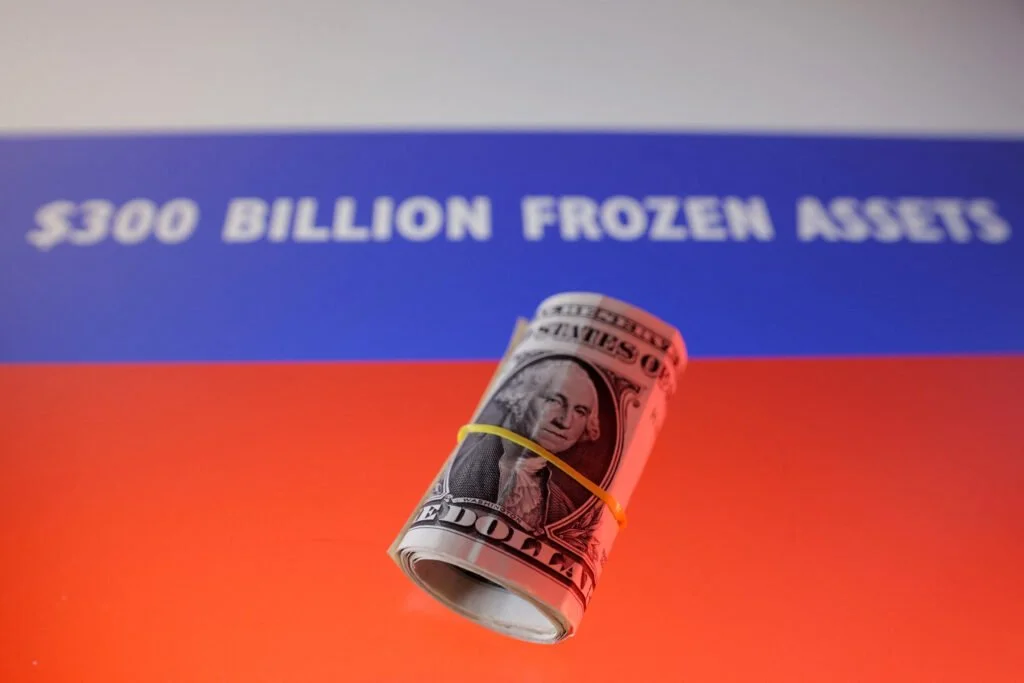
Roughly $300 billion in Russian sovereign assets has been immobilized across G7 jurisdictions since the 2022 invasion, with the majority — close to $200 billion — held in Europe at the Euroclear depository in Belgium.
A smaller, but still substantial, share falls under U.S. jurisdiction, and it is this share that the SABER Act would unlock for defense purchases. Meanwhile, Ukraine's Ministry of Finance has projected financing needs of nearly $45 billion for 2026 alone, and close to $75 billion through 2027 if the war continues.
Set against that need, redirecting even a portion of seized Russian capital toward defense materially closes the gap — without adding a dollar to the U.S. deficit. As Senator Grassley put it, this support "comes at no cost to the American taxpayer."
Why This Matters
The SABER Act does three things at once.
It shifts the financial burden of this war from Ukraine's allies onto the aggressor, reinforcing the principle that wars of conquest carry a price for the country that starts them.
It gives Ukraine a steady source of funding for defense procurement at a moment when traditional appropriations face political headwinds in Congress.
And it signals continued American resolve, exactly the kind of durable, year-after-year commitment that deters further escalation rather than inviting it.
The bill is now before Congress.
Contact your Members of Congress today and urge them to support the Seized Assets for Battlefield Equipment and Readiness (SABER) Act.