
Could Ukraine's Drone Expertise Reshape U.S. Defense Strategy?
Four years into a full-scale war that few expected to last this long, Ukraine has become one of the most closely watched laboratories for unmanned warfare in the world. On June 30, 2026, a bipartisan group of U.S. lawmakers introduced legislation designed to turn that battlefield experience into a formal, lasting partnership with the United States.
The Strategic Unmanned Systems Partnership Act (H.R. companion tracked as S. 4711) proposes a new working group between the U.S. Department of Defense and the Armed Forces of Ukraine — one built to accelerate how quickly proven, cost-effective technology moves from the battlefield into production.
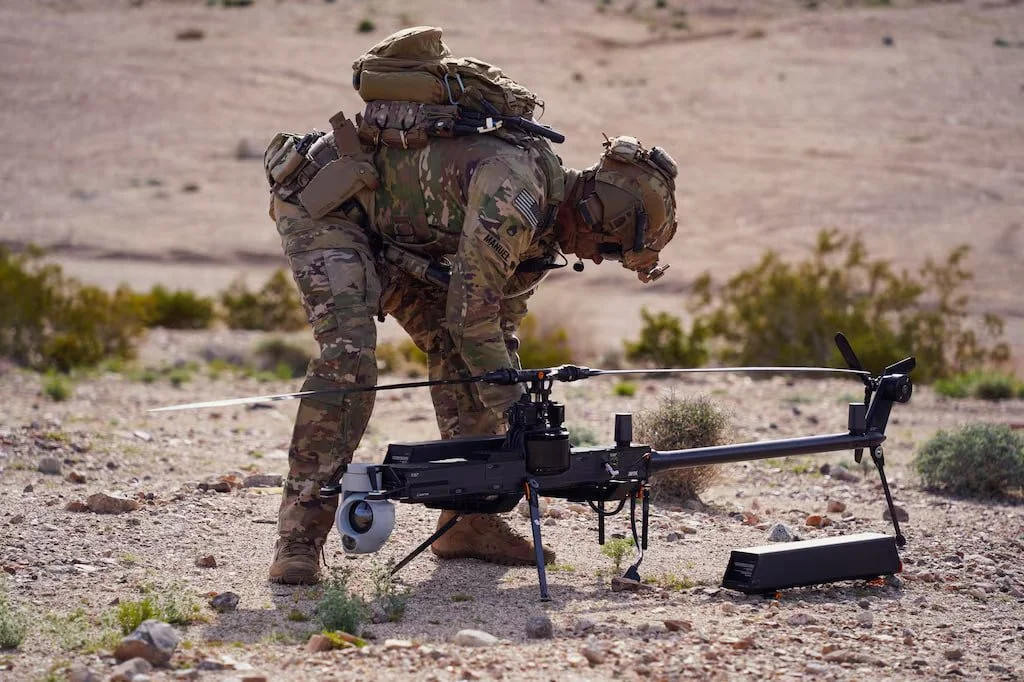
Staff Sgt. LaShic Patterson/U.S. Army
What the Bill Would Do
The legislation would establish a United States–Ukraine Strategic Defense Innovation Working Group tasked with co-developing, co-producing, and rapidly acquiring Ukrainian-designed unmanned systems, including drones and unmanned surface vehicles, along with technologies capable of countering them. Rather than treating Ukraine solely as a recipient of aid, the bill frames the relationship as a two-way exchange:
Ukraine contributes real-world, battle-tested innovation, and the U.S. gains faster access to systems already proven under combat conditions.
A Bipartisan Coalition on Capitol Hill
The bill was introduced by Chairman Emeritus of the House Foreign Affairs Committee Michael McCaul alongside Congressional Ukraine Caucus Co-Chairs Marcy Kaptur, Brian Fitzpatrick, and Mike Quigley, joined by Congressman Jim Costa and Congressman Don Bacon, Chairman of the House Armed Services Subcommittee on Cyber, Information Technologies, and Innovation.
Its sponsors span both parties, and several described the measure as a way to keep American forces ahead of a rapidly evolving battlefield while strengthening the U.S. defense industrial base at home.
Why Ukraine's Experience Matters to U.S. Readiness
Supporters of the bill point to a consistent theme: Ukraine has had to innovate under pressure in ways that few military establishments ever have to.
Lawmakers backing the measure described Ukrainian engineers and operators as having effectively redefined how unmanned systems are used in modern conflict, and argued that integrating those lessons into U.S. planning could directly improve the safety of American servicemembers and strengthen homeland defense against similar threats.
Companion Legislation in the Senate
A parallel bill was introduced in the Senate by Senator Jacky Rosen and Senator Mike Rounds, giving the effort bicameral, bipartisan backing. Coordinated action in both chambers increases the likelihood that the working group concept moves forward as a durable framework rather than a one-time gesture, regardless of the political calendar.
Analysis: A Partnership Built on Mutual Benefit
What distinguishes this legislation from earlier aid packages is its framing. It is not structured as a request for charity, but as an investment with returns on both sides of the Atlantic.
Ukraine's defense sector has, out of necessity, become a testing ground for technologies the rest of the world is only beginning to field. Formalizing a channel for the U.S. to learn from, and manufacture alongside, Ukrainian innovators could shorten procurement timelines that traditionally take years, while also creating manufacturing opportunities within the United States.
In that sense, the bill reflects a broader shift in how Washington is beginning to talk about support for Ukraine: not only as solidarity in wartime, but as a long-term strategic and industrial partnership that continues to pay off well after any ceasefire.