
How Cutting Red Tape Can Help Ukraine Win the Artillery War
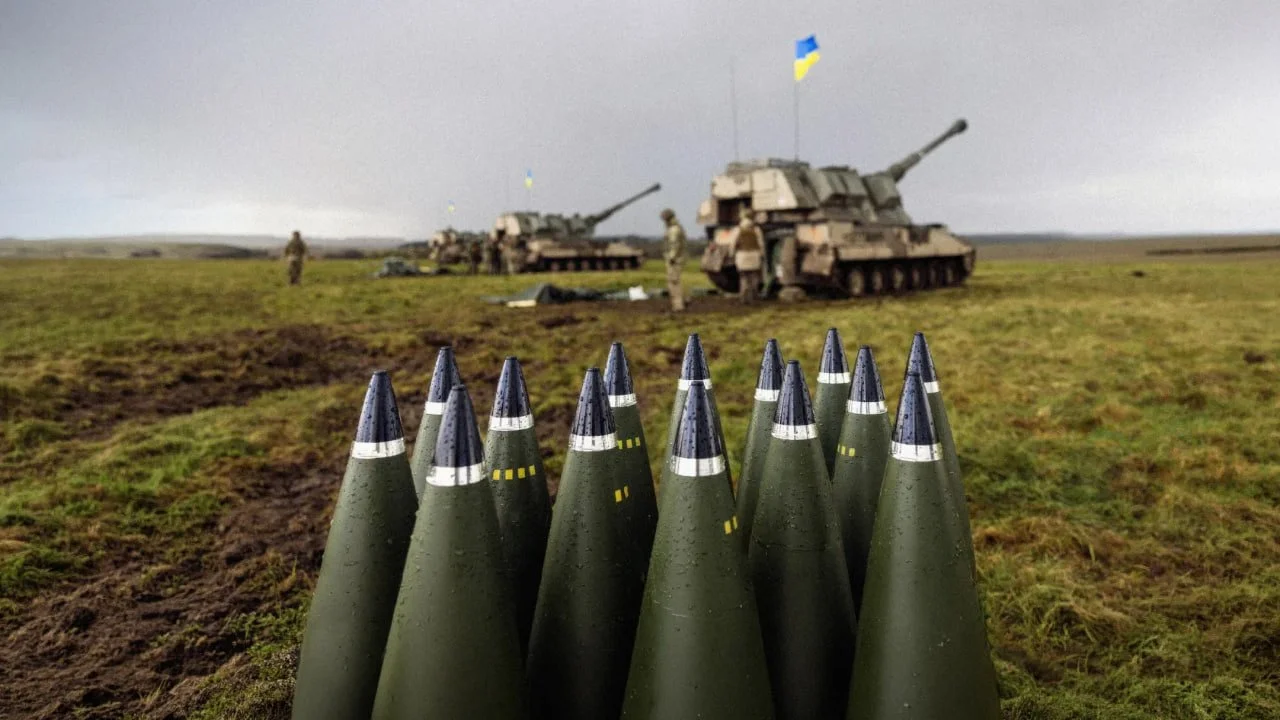
Artillery remains the backbone of Ukraine's defense.
Yet even as European allies stand ready to purchase American-made munitions and send them to the frontlines, each transfer must first pass through a lengthy U.S. arms export approval process, often for the very same shells, over and over again.
A new bipartisan bill in the U.S. Senate aims to fix that. The Fast Tracking European Investment in Ukraine's Defense Act, introduced by Senators Tim Kaine (D-VA) and John Cornyn (R-TX), would pre-authorize allied transfers of critical, high-volume munitions to Ukraine — turning weeks of paperwork into immediate battlefield support.
Here is Why This Legislation Matters
And why it deserves broad support in Congress.
1. The Problem: A Process Built for Peacetime, Applied in Wartime
Under the Arms Export Control Act (AECA), when a NATO ally buys American defense articles and later wants to transfer them to a third country, the United States must approve that retransfer. This safeguard exists for good reason: it keeps American weapons from ending up in the wrong hands.
But in the context of Ukraine's defense, the process has become a bottleneck. Many of these transactions involve identical, well-understood, low-tech munitions — 155mm artillery shells and rocket artillery rounds — going to the same recipient: the Government of Ukraine. Reviewing each shipment individually adds no meaningful security value. It only adds time. And on the frontline, time is measured in lives.
2. The Solution: Pre-Approval for a Narrow, Clearly Defined Category
The Kaine–Cornyn bill amends Section 3 of the AECA to pre-approve transfers to Ukraine — but only under strict conditions:
Trusted sellers only. The purchaser must be a NATO member government or the government of Australia, Japan, the Republic of Korea, Israel, or New Zealand.
One recipient only. The defense articles may go to the Government of Ukraine — no one else.
Four munition types only. 155mm artillery shells, 155mm Excalibur extended-range shells, HIMARS munitions, and GMLRS munitions. These are the workhorse systems of Ukraine's defense, not sensitive next-generation technology.
A written commitment from Kyiv. Ukraine must formally guarantee — in writing, to the U.S. Government and to the relevant congressional committees — that it will not retransfer these articles without the President's consent.
A clear time limit. Ukraine must take title and custody of the articles before December 31, 2030, with annual one-year extensions possible through 2035, but only if the Secretary of State certifies to Congress that Russia is still executing its invasion.
This is not a blank check. It is a carefully bounded fast lane for exactly the munitions Ukraine consumes fastest.
3. Oversight Stays Intact
A common concern with any streamlining of arms exports is the loss of accountability. This bill anticipates that concern directly:
Before any pre-approved transfer takes place, the President must notify the Speaker of the House, the House Foreign Affairs Committee, and the Senate Foreign Relations Committee.
All end-use monitoring requirements remain fully in force.
Any future retransfer request by Ukraine remains subject to every relevant provision of the AECA.
In other words, Congress is not stepping back from oversight — it is stepping back from redundant paperwork. Visibility is preserved; delay is removed.
4. Burden-Sharing That Works for America
The strategic logic of this bill extends beyond Ukraine. When European allies purchase American-made munitions for transfer to Kyiv, three things happen at once:
Ukraine gets supplied faster. High-volume munitions reach the front without repeated administrative cycles.
Allies share the financial burden. European and partner governments pay for the munitions, easing pressure on U.S. appropriations while keeping Ukraine armed.
The U.S. defense industrial base grows stronger. Sustained allied orders provide the long-term demand signal American manufacturers need to expand production lines — capacity that serves U.S. national security well beyond this war.
This is burden-sharing in its most concrete form: allied money, American industry, Ukrainian defense.
A Model for Wartime Alliance Management
The deeper significance of this legislation lies in what it signals. For years, the debate over supporting Ukraine has often been framed as a choice between American resources and American restraint. The Kaine–Cornyn bill demonstrates a third path: building legal infrastructure that lets the entire alliance work at wartime speed.
The bill is also notable for what it does not do. It does not lower standards, expand the list of eligible weapons beyond proven artillery systems, or remove Ukraine's non-retransfer obligations. Its sunset-and-certification mechanism ties the fast track directly to the continuation of Russia's invasion — creating a framework that lasts exactly as long as the threat does.
If enacted, this approach could become a template for future coalition defense efforts: identify the routine, high-volume transactions; pre-approve them within strict guardrails; keep Congress informed; and reserve case-by-case review for genuinely sensitive systems. That is how a rules-based alliance outpaces an aggressor.
Conclusion: Speed Is Support
Ukraine's defenders do not lack the will to fight, and America's allies do not lack the will to help. What has been lacking is a process fast enough to match both. The Fast Tracking European Investment in Ukraine's Defense Act closes that gap.
Source: Office of Senator Tim Kaine