
At the American Ukraine Committee, we work on one relationship:
Congress and Ukraine.
We try to do it with numbers. Every relevant vote gets counted, every member gets a rating, and the same method sits behind our Ukraine Champions list. We publish the votes and the rating, and then we stop. We don't guess the reason why a Congressman voted the way he did.
That discipline holds up fine on a scorecard. It starts to buckle the moment you have to write a sentence.
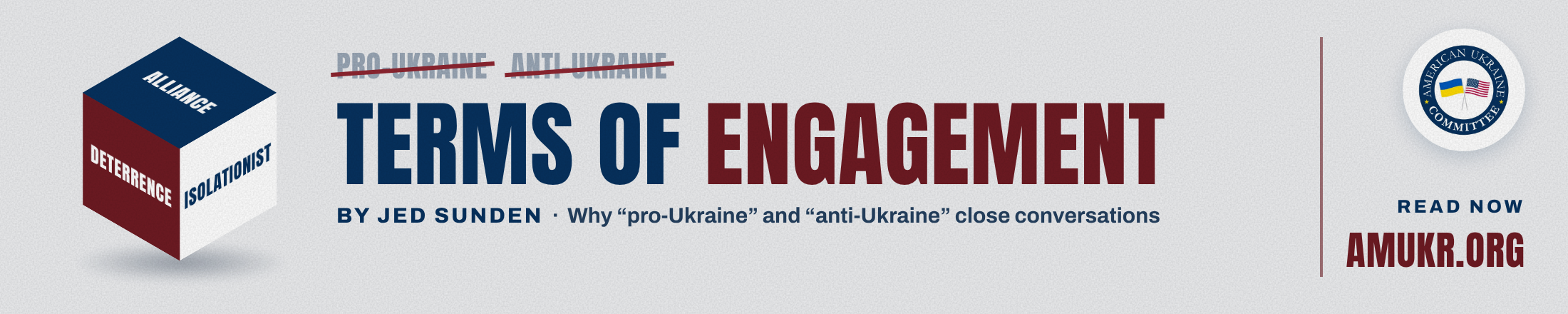
Where "Pro" and "Anti" Stop Working
Sometimes pro-Ukraine and anti-Ukraine are exactly the right words, and nobody is confused. But, too often, pro- or anti-Ukraine is in the eye of the beholder. The partisan eye of the beholder.
Take Lindsey Graham. Was he pro-Ukraine or anti-Ukraine? He wrote the Russia sanctions bill and carried it — the thing has his name on it. He also said some ugly things about President Zelensky. Depending on which half you quote, you can prove whatever you walked in wanting to prove.
Run it the other direction and the problem doesn't go away. There are Democrats who supported Ukraine under Biden but abandoned Ukraine en masse over the Russia sanctions bill.
Labelling pro- or anti-Ukraine shuts down conversations rather than aiding advocacy.
Campaigns Make It Worse
A challenger has no record, so there is nothing to count. What there is instead is a pile of tweets and a stump speech. All year, supporters on both sides sent us that material, eager to prove their candidate was the real pro-Ukraine choice.
I appreciate the kind words, but we don’t score them. A campaign promise is not a vote, and it does nothing for the American-Ukraine relationship.
We are also not in the business of reading hearts. Churchill said that if Hitler invaded Hell, he would make a favourable reference to the Devil. Same here: I'd say something nice about Genghis Khan if it weakened the Russian war machine. Neither motive nor mind-reading is our department.
The Partisan Reflex:
Labels Close Conversations
Partisan political labels have a similar problem. The second you write MAGA, or progressive, or DSA, the argument stops being about Ukraine and turns into an argument over semantics. Is Speaker Johnson MAGA, and is that why the supplemental sat for months? Is Senator Warren a progressive? It closes minds rather than finding common ground.
So I went looking for language that is clear and, as far as possible, politically neutral.
For the Anti: Isolationist
For members likely to vote against Ukraine, whichever party they come from, I use isolationist. Its meaning is clear. It works for both sides of the aisle, and you can connect the policies that flow from the label.
Louisiana is the Republican example. Bill Cassidy lost his own primary. His replacement comes from the isolationist wing of the Republican Party.
Michigan is the Democratic one. Gary Peters retired, and Abdul El-Sayed won the seat. He comes out of the isolationist wing of the Democratic Party.
Notice what that word is not doing.
It makes no claim about where either of them stands on Ukraine. El-Sayed has never held federal office, so there is no record to grade, and I'm not going to invent one. What the label describes is where the votes are likely to fall on the questions that arrive long before Ukraine gets a line of its own: a smaller Pentagon budget, less weight behind NATO, less of whatever Ukraine needs to win the war. That lean is predictable even when a position on Ukraine isn't.
The opposite of Isolationist?
Alliance and Deterrence
The opposite was much harder to name. Expansionist is wrong. Globalist is worse — it means something else entirely, and half the audience hears an insult. I ended up with two words. Neither is a clean antonym and each carries its own shade of meaning.
Alliance. The Member supports America’s Allies and relying on Alliances for America’s security, NATO in particular. Take this phrase: Chris Coons is the likely incoming Chairman of Senate Foreign Relations. He comes from the Alliance wing of the Democratic party.
Deterrence. A close cousin, leaning harder into military spending, with a deliberate nod to Reagan's posture toward the Soviets. Roger Wicker, the senior Republican on Armed Services, comes from the Deterrence wing of his party.
There is an asymmetry here, and I'll own it. In theory, a member could be pro-Ukraine and sit in the isolationist wing. In practice, I can't picture how. Alliance and Deterrence work differently: they say nothing directly about Ukraine, and that is the point. Those policies help Ukraine whether or not Ukraine was ever the reason for them.
Why Bother
The hardest job in Ukraine advocacy is keeping the issue out of America's domestic knife fight. Every time Ukraine gets filed in one party's column, we lose members we could have kept.
Four words won't fix that. But words are the material we work with, and the ones we had been using kept starting arguments we didn't need to have. Maybe these ones do better.
Every voice counts. Stay with us:
💬 Join our WhatsApp community
📩 Get updates from Capitol Hill
❤️ Help us keep the pressure on