
The Graham Sanctions Bill Is Now S. 5025 — With 61 Cosponsors and Counting
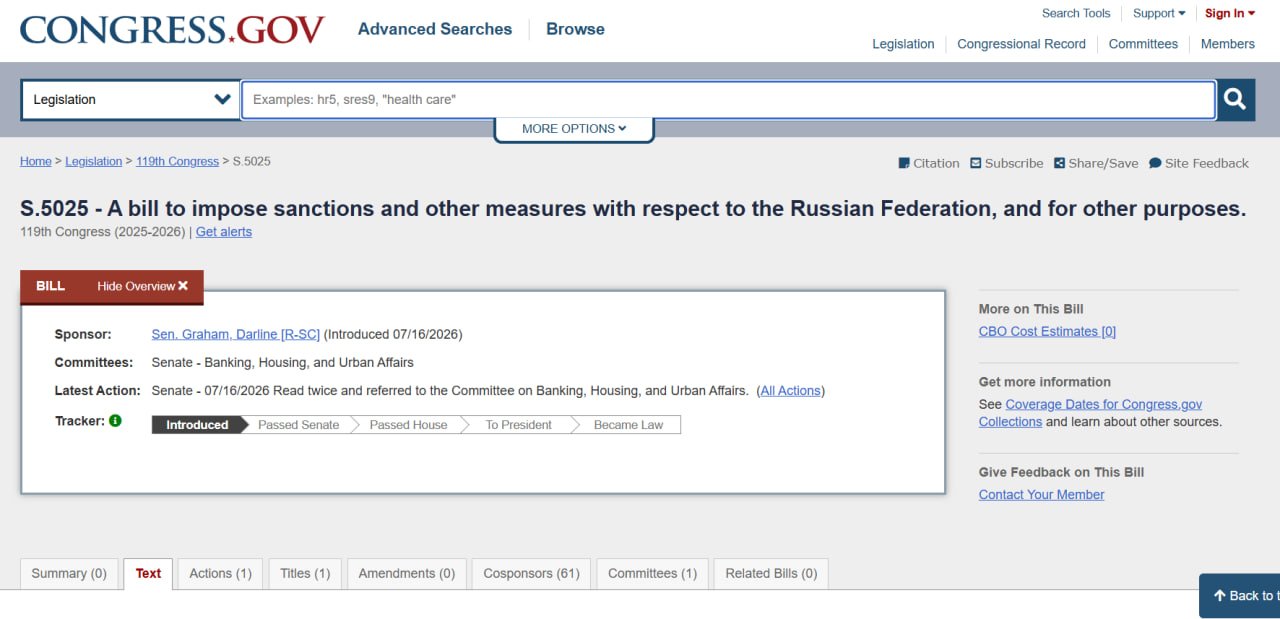
The Sanctioning Russia Act of 2026 has cleared two critical milestones in a single week. The legislation negotiated by the late Senator Lindsey Graham now has an official bill number, S. 5025, and a rapidly growing roster of bipartisan cosponsors, while Senate leadership has taken the first procedural steps toward a floor vote. For everyone who has been urging Congress to act, this is the moment the campaign has been building toward.
Senate Leadership Sets the Stage for a Vote
Senate Majority Leader John Thune (R-S.D.) has taken procedural steps to place House-passed legislation, H.R. 2913, which provides $1.3 billion in security assistance for Ukraine and expands sanctions on Russia, on the Senate calendar. That measure passed the House last month by a vote of 226–195, with eighteen Republicans joining Democrats in support.
The procedural significance is larger than the bill itself. H.R. 2913 could serve as a legislative vehicle, a "shell", for the Graham-negotiated sanctions package, allowing the Senate to begin the often lengthy floor process now, while leaders resolve remaining questions. This sets up a possible vote later in the July work period, before the August recess.
S. 5025 Is Officially Registered
With 61 Cosponsors
On July 16, the Lindsey O. Graham Sanctioning Russia Act of 2026 was formally introduced in the Senate as S. 5025, led by Senators Richard Blumenthal (D-CT) and Darline Graham (R-SC), and referred to the Senate Banking, Housing, and Urban Affairs Committee.
The bill already counts 61 cosponsors, an extraordinary launch for any piece of legislation, and a testament to the cross-party coalition Senator Graham spent his final days assembling.
The cosponsor list spans the ideological spectrum, from Majority Leader Thune to Democrats including Senators Jeanne Shaheen and Kirsten Gillibrand. The White House has signaled its support, an agreement Senator Graham secured just before his passing.
What the Bill Would Do
S. 5025 targets the financial engine of Russia's war. It would impose mandatory sanctions on Russian leadership, the military, banks, energy companies, and the shadow fleet, and direct tariffs of up to 100 percent on the largest foreign importers of Russian crude oil and natural gas, the revenue streams that sustain the Kremlin's aggression.
The updated text reflects careful negotiation: the steepest tariffs are focused on the five largest importers of Russian energy, while U.S. allies that still purchase Russian natural gas, such as France and Japan, are exempted. Senator Blumenthal described the broader approach as a "sledgehammer combination of military support and economic sanctions", pressure designed to bring the war to a just conclusion.
The Remaining Work
The path to passage still requires resolving concerns some senators have raised about applying steep tariffs to major U.S. trading partners that buy Russian oil. These are serious questions of economic statecraft, and the bill's negotiators have already shown, through the allied-nation exemptions, that they can address legitimate concerns without weakening the bill's core.
That is precisely why constituent voices matter now. Sixty-one cosponsors is a commanding start; every additional senator who signs on makes the timeline shorter and the floor vote more certain.
The Window Is Open,
and It Is Measured in Days
Legislative momentum is perishable. A bill with 61 cosponsors, White House backing, a committee referral, and a procedural vehicle already on the Senate calendar is as close to a floor vote as sanctions legislation has ever been. The convergence is not accidental, it is the product of Senator Graham's final push, the bipartisan coalition he built, and sustained public pressure from Americans who believe aggression must carry a price.
The August recess is the natural deadline. If the Senate acts in the July work period, Congress can deliver the strongest Russia sanctions package ever passed, and cement Senator Graham's legacy in the most fitting way possible.
Sources: The Hill