
Pass the Graham Bill. Ukraine Doesn't Have Time for Another Fight
OFFICIAL STATEMENT
Already took action? Take it again — repeated voices are what move a bill to the floor.
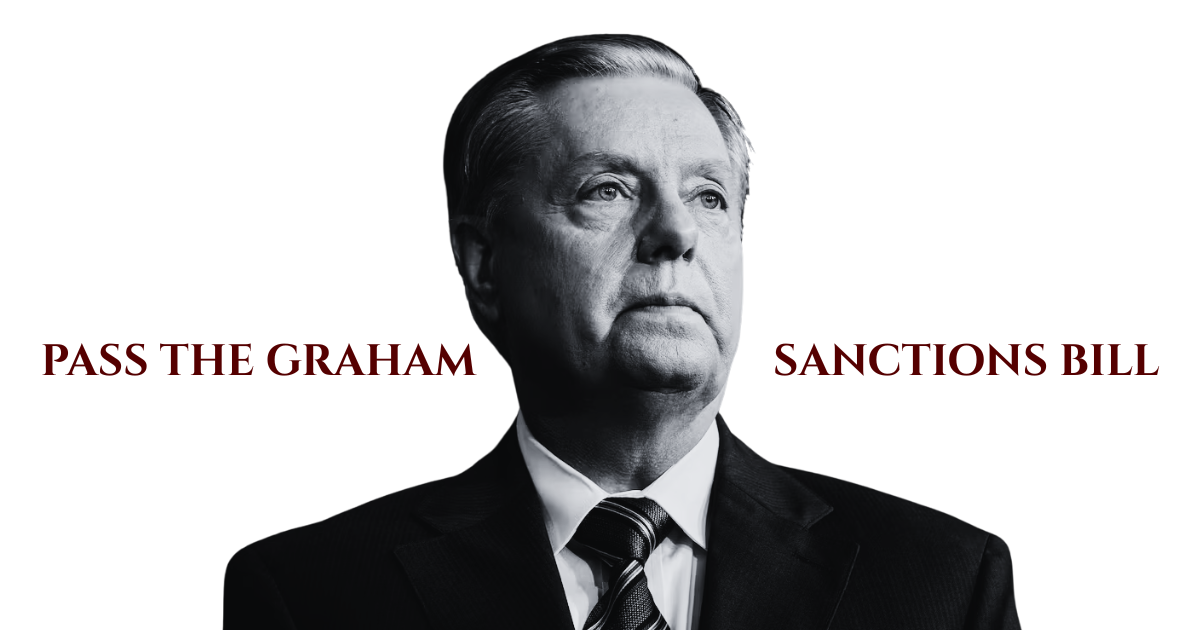
Lindsey Graham spent the better part of two years trying to get a Russia sanctions bill through the Senate. He didn't live to see it pass. Now his colleagues are trying to finish it for him, and they should, not just as a tribute, though it will be one, but because the bill itself is good, and Ukraine needs it more now than it did a year ago.
The revised Sanctioning Russia Act has more than 60 co-sponsors, enough to clear a filibuster without much drama. Republican leadership hotlined it last week. Sen. Richard Blumenthal, one of the Democrats who has stuck with this bill through its many rewrites, has said he expects it to clear the Senate before August. If that holds, it moves to the House next, where Rep. Michael McCaul, who has already written that Congress should "pass it in his honor", is expected to introduce a companion. President Trump has stopped short of a full endorsement but has said more than once that he's "seriously thinking about" signing it, invoking Graham's name when he says so.
That's the mechanics. Here's why it matters: the bill forces mandatory sanctions on Putin, his inner circle, Russian state banks, and the shadow tanker fleet Moscow uses to dodge existing restrictions, all within 30 days of enactment. It also gives the president authority to impose tariffs of up to 100% on the five biggest buyers of Russian oil and gas, China and India chief among them. That is real pressure on the money financing this war. We support the bill. Plainly.
We'd be careless, though, to pretend the tariff provision isn't a genuine sticking point. It is, and the Democrats raising it aren't wrong to.
Rep. Gregory Meeks, the top Democrat on House Foreign Affairs, went further than a general objection. In a statement released this week, he said the bill "misses the moment," arguing that its actual sanctions are left entirely to the president's discretion while Trump has repeatedly signaled he'd rather waive penalties on Moscow than impose new ones. Meeks called the measure "a massive backdoor authority for President Trump to impose more tariffs," including on European allies, and said he'd rather see the Senate redirect its momentum toward a bipartisan, bicameral bill built on the Ukraine Support Act the House passed in June, one that would mandate real sanctions rather than hand the administration another discretionary tool. Leaders of the New Democrat Coalition came out against the bill last week on similar grounds.
The Wall Street Journal's editorial board laid this out fairly in a recent piece: hand a president discretionary tariff power in the name of squeezing Moscow, and you've also handed him a tool he can aim wherever he likes, whenever he likes, for reasons that have nothing to do with Ukraine. That isn't paranoia. It's a plausible read of how this White House has used trade authority before.
We take that concern seriously. We just don't think it should sink the bill.
Here's the trouble: this is starting to feel like the supplemental funding fight all over again, where Ukraine's fate got tangled up in arguments that had almost nothing to do with Ukraine. Then it was border policy. Now it's tariffs. Ukraine isn't a top-tier issue for most of Washington, it hasn't been for a while, and that is exactly why it keeps ending up as the thing traded away or held hostage inside someone else's fight. That's unfortunate. It's also predictable, and it will keep happening as long as passing anything for Ukraine requires strapping it to something voters actually rank as a priority.
Our position is simple: this bill sanctions Russia, and it should pass. If the price of getting there is Trump holding more tariff authority than some of us would design from scratch, that price is not a Ukraine-shaped problem to be relitigated inside a Ukraine bill. Congress can find another vehicle to check tariff overreach if that's the worry. It doesn't need to make Kyiv wait for that debate to resolve first.
House Democrats hold real leverage here, and they should use it, to press for guardrails on how the tariff authority is used, for reporting requirements, for a sunset clause, for whatever gets skeptics comfortable. What they shouldn't do is let that fight become a reason to vote no on sanctioning Russia. Graham didn't spend his final months on this bill, so a tariff argument could bury it in the House.
Pass the bill in the Senate. Get McCaul's companion moving. Bring Democrats along on the substance of the tariff debate instead of losing them to it. Then send the president something to sign, not because it's a memorial, though it will double as one, but because Ukraine needs these sanctions more than Washington needs another proxy fight over trade policy.
First time or fifth — every message counts.
Source: The Wall Street Journal