
Treasury Extends Russian Oil Waiver - Senate Leaders Sound Alarm
On May 18, 2026, the U.S. Department of the Treasury announced a second 30-day extension of a sanctions waiver allowing transactions involving Russian seaborne oil. The waiver - issued after General License 134B expired on May 16 - permits limited access to Russian oil and petroleum products stranded on tankers, without violating broader U.S. sanctions on Russian oil majors.
According to Treasury Secretary Scott Bessent, the extension is intended to help "energy-vulnerable" countries cut off from Gulf oil supplies following the closure of the Strait of Hormuz.
Key Facts
The waiver was first issued in March 2026 and has now been extended for the second time
Benchmark Brent oil futures rose about 1.5% to roughly $111 per barrel on May 18
The Strait of Hormuz remains closed amid the U.S.-Israeli conflict with Iran
Reuters reports the waivers "have done little to reduce oil prices," but have aided India - historically one of the largest buyers of Russian oil
Russian oil revenues remain the single largest source of funding for the Kremlin's war machine
Senate Leaders Sound the Alarm
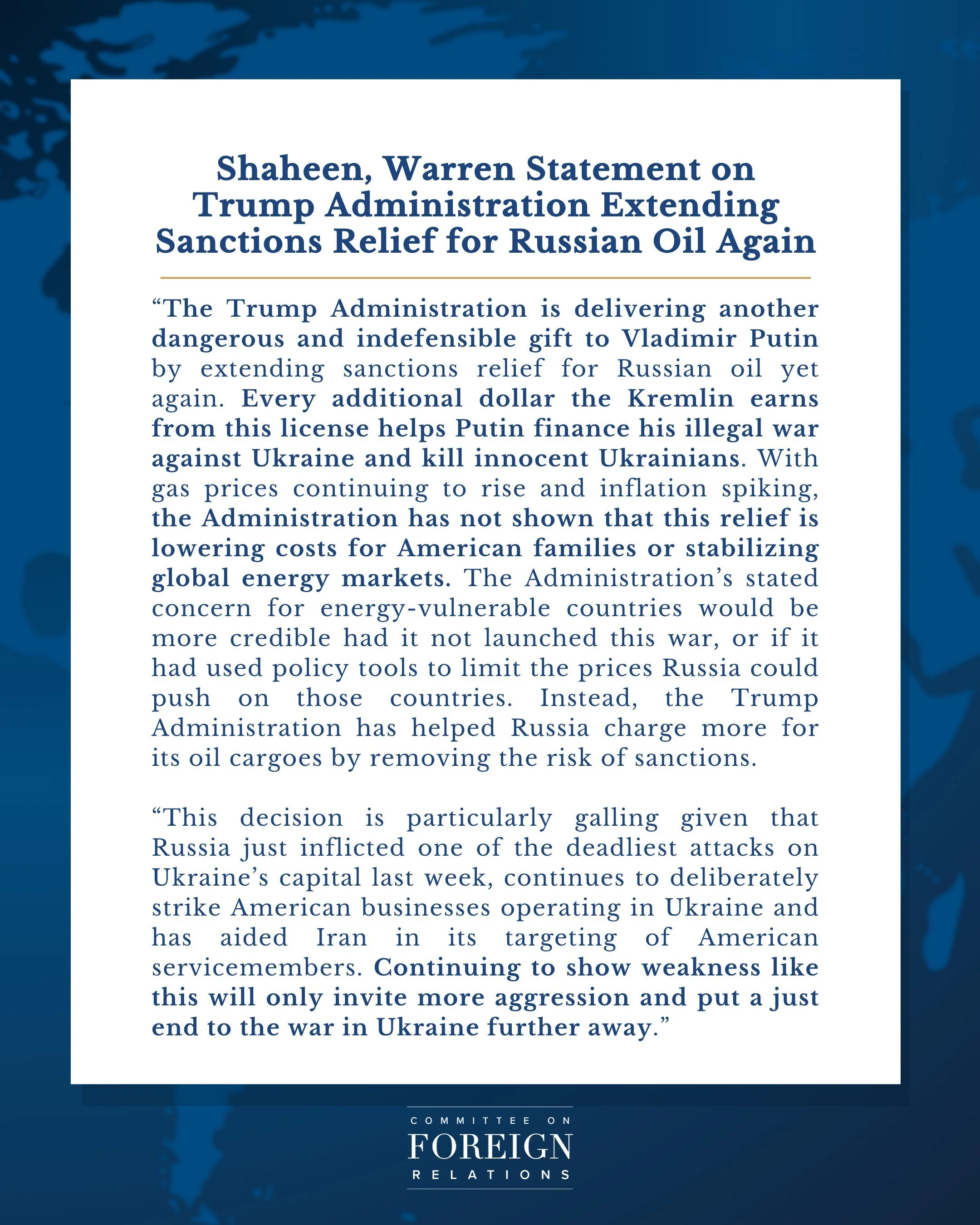
The same day, two of the Senate's most senior voices on foreign policy and financial oversight🔵 Sen. Jeanne Shaheen (D-NH), Ranking Member of the Senate Foreign Relations Committee, and 🔵 Sen. Elizabeth Warren (D-MA), Ranking Member of the Senate Banking, Housing, and Urban Affairs Committee - issued a joint statement urging stronger enforcement of sanctions on Russian oil.
Their warning is clear: every additional dollar Russia earns from oil sales translates directly into the Kremlin's ability to continue its war against Ukraine.
As the senators stated:
"Every additional dollar the Kremlin earns from this license helps Putin finance his illegal war against Ukraine and kill innocent Ukrainians."
They also drew attention to Russia's escalating attacks on Ukraine and on American businesses operating there:
"Russia just inflicted one of the deadliest attacks on Ukraine's capital last week, continues to deliberately strike American businesses operating in Ukraine and has aided Iran in its targeting of American servicemembers."
The senators called for stronger, not weaker, sanctions enforcement, arguing that maintaining pressure on Russia is essential to achieving a just end to the war.
Thank You, Senators
The American Ukraine Committee is grateful to:
🔵 Sen. Jeanne Shaheen (D-NH) - for her unwavering, years-long leadership in defending Ukraine and pushing for stronger sanctions on Russia. Senator Shaheen has been one of the Senate's most consistent and informed advocates for Ukraine's sovereignty.
🔵 Sen. Elizabeth Warren (D-MA) - for using her oversight role on the Banking Committee to highlight how every loophole in U.S. sanctions translates into more revenue for the Kremlin's war effort.
Their joint statement is exactly the kind of clear, principled leadership Ukraine needs from the U.S. Senate.
The Legislative Solution: H.R. 8222
Congress has a direct tool to address this problem. The End Russian Oil Windfalls Act (H.R. 8222), sponsored by 🔵 Rep. Gregory W. Meeks (D-NY-5), Ranking Member of the House Foreign Affairs Committee, would:
Terminate existing Russia-related General Licenses for the sale of Russian oil
Prohibit the issuance of such licenses in the future
Impose stronger sanctions on Russian oil companies
Require transparency reports on Russian oil revenues - and on the role of Russian energy companies in the abduction, deportation, and indoctrination of Ukrainian civilians, including children
In short, H.R. 8222 closes the loophole, restores the integrity of U.S. sanctions, and ensures American policy aligns with American principles - that aggressors should not profit from their aggression.
The Bottom Line
Sanctions only work when they are enforced consistently. Every extension of the Russian oil waiver - however limited - sends a signal that the pressure on Moscow can be eased while the war continues. That signal must be replaced with a stronger one: Russia will not profit from its aggression against Ukraine.
H.R. 8222 gives Congress the opportunity to send that message clearly and durably.