
Ukraine's Reconstruction: Strong Commitments, Weak Coordination?
The annual Ukraine Recovery Conference opened this week in Gdansk with a question that no one is quite saying out loud: not whether the world will support Ukraine's reconstruction — at this point, that's settled — but whether all that support actually adds up to something.
Right now, it doesn't. Not fully.
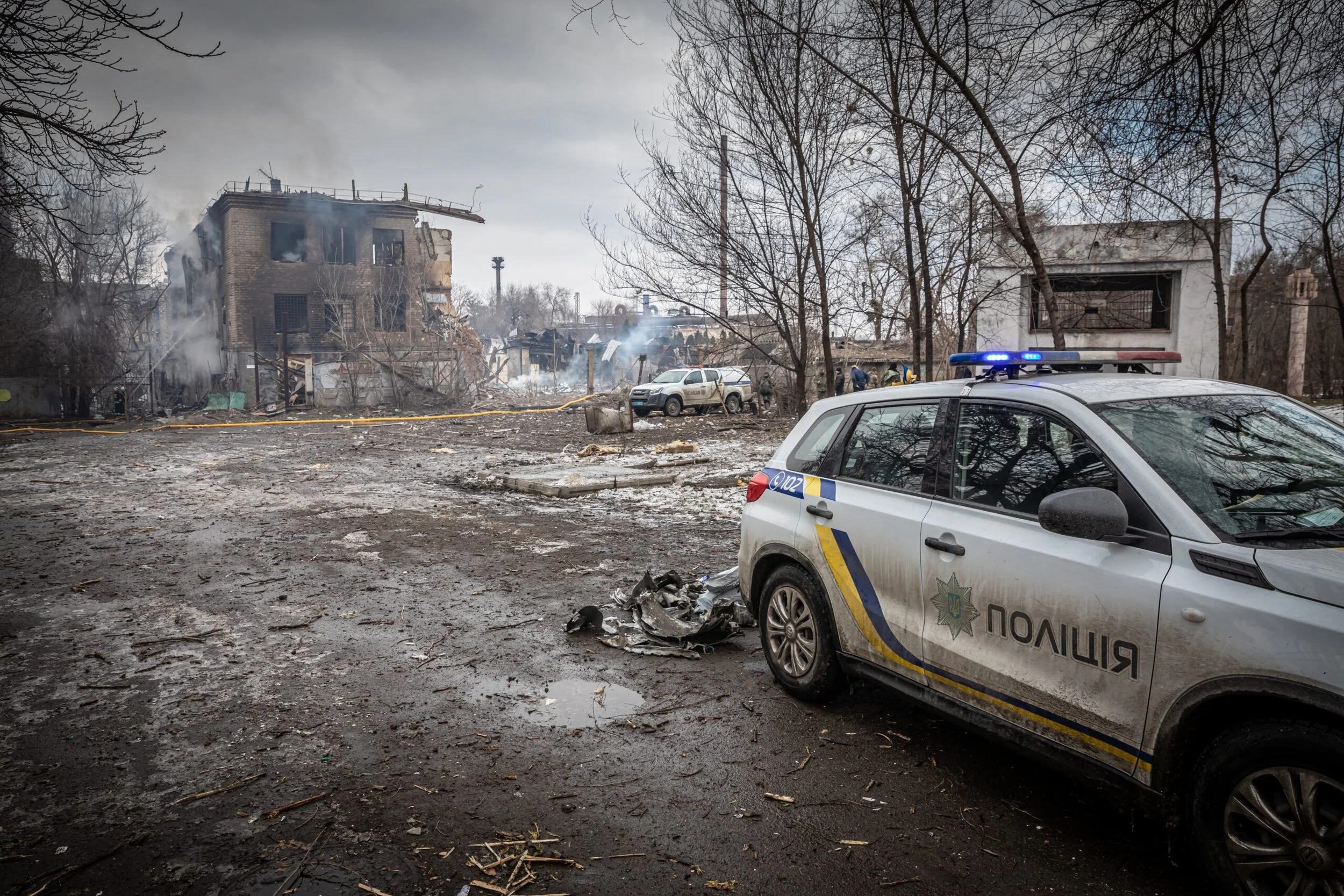
Russian destruction of Dnipro, Ukraine, circa March 2022. Ukraine’s reconstruction will largely depend on European coordination. (Shutterstock/Vojtech Darvik Maca)
The Progress Is Real
Start with what Ukraine has actually built, because it's easy to underestimate. While fighting a full-scale war, the country has overhauled public investment management, stood up transparent procurement platforms — DREAM and ProZorro — and created a vetted pipeline of priority projects ready for donor review. A strategic investment council is now making hard calls about where state money goes.
None of that is cosmetic. It's the structural scaffolding without which no recovery program works. The fact that Ukraine built it under daily bombardment says something about institutional capacity that tends to get lost in the bigger headlines.
So What's Missing?
Here's the awkward part. Dozens of partners are doing real work — the EU, G7, IMF, World Bank, bilateral donors — and yet the system as a whole isn't coherent. Infrastructure funding runs separately from governance reform. Accession benchmarks sit alongside, rather than inside, investment planning. Donor programs are catalogued but not coordinated.
Every actor in this space tends to describe the same underlying problem through a different lens. One sees a planning gap. Another sees a project preparation bottleneck. A third sees a political reform issue. They're all partly right, and that's precisely the problem — the diagnosis keeps getting fragmented along the lines of each organization's mandate.
Analyst Luke Zahner, writing after the Gdansk conference, put it plainly: Ukraine needs donor activity aligned with its medium-term priorities, recovery projects linked to structural reform, and technical assistance that actually connects to private-sector confidence. Not three separate things. One thing.
The Marshall Plan Gets Cited A Lot. Here's the More Useful Comparison.
The Marshall Plan analogy keeps coming up, and it has some value — mainly as a reminder that recovery requires scaffolding, not just money. But the structural difference is significant. Post-WWII, one country coordinated the reconstruction of many. Today, many countries are trying to coordinate the reconstruction of one. That flip changes the coordination math entirely.
The Baltic model is more instructive. Estonia, Latvia, and Lithuania didn't get into the EU through technical compliance alone. They got there because international partners were working inside their systems — not just funding projects or issuing benchmarks from outside. Partners embedded in ministries, pushing reforms, maintaining pressure, and staying long enough to see things through.
Ukraine's situation is harder, obviously. But the principle is the same: sustained presence matters more than well-designed programs run from a distance.
Private Investment Is Watching the Enabling Environment, Not the Announcements
There's been no shortage of deal announcements for Ukraine — energy, critical minerals, infrastructure, and defense. Some of those are becoming real investments. Many aren't, at least not yet.
The gap isn't interesting. Its conditions. Investors need bankable projects, predictable regulation, functioning public counterparts, and financing instruments that account for wartime risk. Where those things exist, deals close. Where they don't, you get press releases.
This is why capacity building is worth taking seriously as an economic argument, not just a development one. It's the groundwork that allows capital to move toward projects that are actually investable. Without it, you get the appearance of momentum without the underlying transactions.
Sanctions and Recovery Are the Same Conversation
There's a tendency to treat Ukraine's reconstruction and economic pressure on Russia as separate policy files. They aren't.
Russia finances this war primarily through energy revenue. Oil and gas exports fund the missiles, the personnel, the occupation. Every dollar that reaches the Kremlin through energy markets — including through third-party evasion networks and shadow fleet workarounds — is a dollar that extends the destruction Ukraine is trying to repair.
Maintaining strong, fully enforced sanctions on Russian oil isn't a side issue to Ukraine's recovery. It's directly connected to how long recovery will take and how much it will cost. Weakening the G7+ price cap now, while reconstruction is just beginning to gain traction, works against every other investment being made in Ukraine's future.
What Gdansk Should Actually Produce
Conferences generate communiqués. This one should generate a clearer answer to a specific question: who is responsible for the connective tissue?
Ukraine has proved it can function, reform, and adapt under conditions no country should have to face. The job for its partners now is to organize their support well enough to match that. Integrated strategy over scattered projects. Enabling conditions over deal announcements. Sustained engagement over pledging cycles.
The pieces are there. The architecture still needs work.
📰 Source: Luke Zahner, "How to Rebuild Ukraine," June 24, 2026