
US-Ukraine Policy Needs a Full Bench to Win the Peace
By Jed Sunden | August 14, 2026
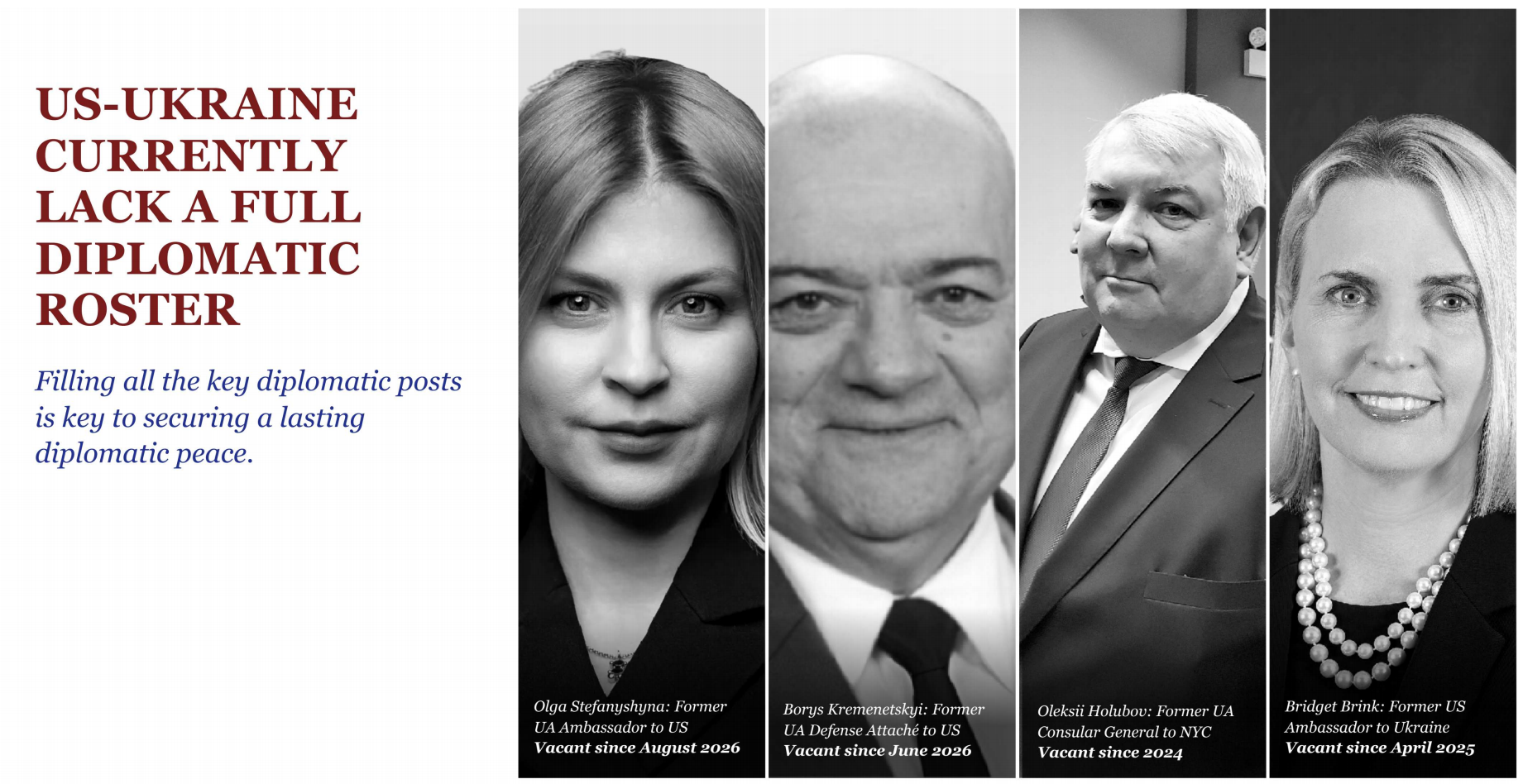
Count the empty chairs.
In Washington, Ukraine has no confirmed ambassador following the departure of Olha Stefanishyna, who served less than one year. Additionally, Ukraine has no defense attache in DC nor consul general in New York. On the American side, the situation is similarly stalled: the U.S. Embassy in Kyiv is currently led by an interim chargé d'affaires. She was appointed after the abrupt resignation of the Biden-appointed Ambassador. While she has 3 decades in the State Department, she lacks a background in the region.
It is true that both President Donald Trump and President Volodymyr Zelensky are well-known for running direct foreign policy outside traditional diplomatic channels. Leader-to-leader diplomacy and trusted envoys can break through bureaucratic inertia with decisive speed. But fully-staffed Embassies are complimentary to the meetings of the Presidents and the work of Presidential Envoys Witkoff and Kushner.
President Zelensky is coming to New York in September to meet with President Trump and world leaders at the UN General Assembly next month. Both Washington and Kyiv face an immediate, low-cost opportunity to supercharge their partnership: fill the empty seats and put a full diplomatic bench on the field.
The rationale goes far beyond ceremonial representation. Behind the headlines lies an unprecedented array of high-value economic and security opportunities that require day-to-day institutional leadership to realize.
Consider defense innovation. Ukrainian and American forces now possess four years of shared battle-tested learning in drone employment, electronic warfare, counter-battery operations, and real-time operational logistics. Ukrainian engineers are pioneering tactical doctrine in real time that Western planners are still modeling. Ukrainian producers have announced joint ventures and local manufacturing in Ohio, Texas and Arizona. The projects help protect America as well as create high-paying manufacturing jobs.
Yet defense partnerships do not assemble themselves. Export licenses, ITAR compliance, Development Finance Corporation (DFC) guarantees, and Pentagon program requirements require continuous, hands-on coordination. There is plenty of work for both Embassies to facilitate joint production projects.
The broader economic opportunity is equally immense. Ukraine’s reconstruction will represent the largest infrastructure and modernization market in Europe for a generation—spanning energy grid resilience, modern rail networks, commercial housing, advanced agriculture, and deep-water ports. U.S. firms deserve a strong Ambassador who can lobby on their behalf.
European security policy is changing and NATO policy is adjusting. Ukraine’s battle-tested military represents a vital partner in European stability. Washington remains the premier arena for allied coordination; ensuring Ukraine has full, high-level diplomatic representation in D.C. ensures American and Ukrainian policy remains aligned.
Finally, if American wants to broker a peace agreement, a strong Ambassador with experience in the region can assist Envoys Witkoff and Kushner. Enduring stability will demand rigorous verification, monitoring, and legal mechanisms. Strategic frameworks established at the presidential level must be operationalized by a fully staffed Embassy.
Solving this challenge does not require massive legislative appropriations or intractable political negotiations. It simply requires placing qualified, authoritative leadership into key posts.
Kyiv should move swiftly to dispatch an ambassador to Washington who can speak directly to defense industrial integration, alongside filling its diplomatic rosters in New York and the Pentagon. Simultaneously, Washington should nominate a full Ambassador to Kyiv, someone with experience in the region and knowledge of the Ukrainian political and business landscape, who can vigorously execute the President’s agenda and champion American business interests on the ground.
The U.S.-Ukraine partnership is important and filled with opportunities for cooperation. American security is reinforced by a strong Ukraine, and American business deserve representative who ensure access to reconstruction opportunities. By equipping both capitals with a full team of diplomatic heavyweights, both nations can convert strategic vision into tangible economic and national security wins.
Jed Sunden is the founder and director of the American Ukraine Committee and the American Ukraine Political Action Committee. Previously, he founded the leading internet and news company in Ukraine.