
America at 250: Why Does U.S. Leadership Still Matter for the World?
On July 4, 2026, the United States marked its 250th anniversary, and the American Ukraine Committee congratulates the American people on this historic milestone.
Hegemonic Stability Theory:
Why the World Needs a Leader
To understand why American leadership matters — not just for Ukraine, but for the entire international system — it is worth turning to one of the most influential frameworks in international relations: Hegemonic Stability Theory (HST).
Developed by economist Charles Kindleberger and refined by political scientists including Stephen Krasner and Robert Gilpin, the theory holds that an open, stable, and prosperous international order is most likely to exist when a single leading power — a hegemon — is willing and able to provide global public goods: secure trade routes, a stable reserve currency, open markets, enforcement of common rules, and deterrence of aggression.
Kindleberger's famous study of the 1930s reached a sobering conclusion: the Great Depression became a global catastrophe in part because no state was willing to lead. Britain no longer could; the United States, at that time, chose not to. The result was protectionism, economic collapse, and ultimately world war. Krasner's later work showed the other side of the coin: when a hegemon actively supports openness — as the United States did after 1945 — trade expands, institutions flourish, and conflict between major powers becomes less likely.
The post-1945 order — the United Nations, NATO, the Bretton Woods institutions, the open trading system — was not an accident. It was built and sustained by American leadership. The peace and prosperity that followed were, in the language of HST, public goods underwritten by a hegemon that saw its own interest in a rules-based world.
Ukraine is where this theory meets reality today. Russia's war is a direct assault on the foundational rule of the American-led order: that borders cannot be changed by force. Hegemonic Stability Theory predicts what happens when such challenges go unanswered — rules erode, aggression spreads, and the costs of restoring order multiply. It also predicts what happens when the leading power responds with resolve: the system holds, deterrence is restored, and stability returns.
In this sense, standing with Ukraine is not a departure from 250 years of American tradition. It is its logical continuation. The hegemon's role is not domination — it is stewardship of a system in which free nations, large and small, can thrive. That is the leadership the world has come to expect from the United States, and it is the leadership Ukraine's defense now reaffirms.
The American Experience:
Lessons for the Black Sea Region
For 250 years, American leadership has shaped international prosperity and security through diplomacy, humanitarian support, economic partnership, and, when necessary, resolve in the face of aggression.

The first lesson of the American experience is that independence must be won, and then it must be built. The United States did not become a global leader in 1776.
It became one through generations of institution-building: a constitution that limits power, courts that uphold law, a free press that holds leaders accountable, and an economy open to talent and enterprise. For Ukraine and its Black Sea neighbors — Romania, Bulgaria, Georgia, Moldova, and Türkiye — the message is clear: security and prosperity are not gifts of geography. They are products of strong institutions, regional cooperation, and integration into the community of free nations.
The second lesson is that freedom is a shared project. America's founders understood that a young republic could not survive in isolation; they sought alliances, trade, and recognition. Today, the Black Sea region's pursuit of peace and opportunity follows the same logic. Freedom of navigation, secure trade corridors, energy diversification, and resilient food-export routes are not national projects — they are regional and transatlantic ones. American engagement in the Black Sea reflects enduring U.S. interests: open sea lanes, stable energy markets, food security for the world, and a Europe whole, free, and at peace.
The third lesson is that values and interests are not opposites. American engagement in the region is driven by both. A stable, democratic, and prosperous Black Sea region means reliable partners, growing markets, and fewer crises that demand costly intervention. Supporting Ukraine's sovereignty is therefore not charity — it is strategy, rooted in the same principles that have guided American foreign policy at its best for 250 years.
American Leadership in an Era of Strategic Competition
Democracies debate. Priorities shift between administrations. This is not a weakness of the American system — it is its design. Yet through every transition of power for two and a half centuries, one constant has remained: America plays a leadership role in global affairs.
What does that leadership look like today, in an era of strategic competition, technological transformation, and new economic opportunities?
First, leadership means setting standards. From aviation to the internet, from financial systems to artificial intelligence, the rules that govern global technology and commerce are written by those who lead. American leadership ensures that emerging technologies — AI, advanced manufacturing, biotechnology, space — develop within frameworks that protect freedom, privacy, and open markets rather than enabling surveillance and coercion.
Second, leadership means building coalitions. The defining feature of American power has never been unilateral strength alone — it has been the ability to unite allies around common purpose. The coordinated international response to Russia's full-scale invasion of Ukraine, including the G7+ sanctions architecture and unprecedented security assistance, demonstrates that American convening power remains unmatched.

Third, leadership means investing in partners. Ukraine today is not merely a recipient of support — it is a contributor to transatlantic security.
Ukrainian innovations in drone warfare, battlefield medicine, cyber defense, and rapid defense manufacturing are already reshaping how free nations think about deterrence. American engagement with Ukraine is a two-way street of technology, experience, and resolve — a modern expression of the alliances that have defined American success since 1776.
Religious Freedom:
A Founding Principle and a Living Bond
Religious freedom has been part of the American story since before the nation's founding. Pilgrims and dissenters crossed an ocean to worship freely. The First Amendment enshrined freedom of conscience as the first freedom — the conviction that no government may stand between a person and their faith.
Two hundred fifty years later, this principle remains one of the deepest bonds between the American and Ukrainian peoples. Connections between American and Ukrainian faith communities are among the strongest people-to-people ties linking the two nations — a relationship that runs deeper than any government-to-government framework.
Ukrainian churches across America — Orthodox, Greek Catholic, Protestant, and evangelical — have anchored diaspora communities for generations. Since 2022, American congregations of every tradition have organized humanitarian aid, welcomed displaced families, funded medical evacuations, and prayed for peace. Ukrainian believers, in turn, have shown the world what faith under fire looks like: chaplains serving on the front lines, parishes sheltering the displaced, and communities rebuilding churches destroyed by missile strikes.
This bond carries moral weight. In territories under occupation, religious communities face persecution, and houses of worship have been damaged or destroyed across Ukraine. For Americans, whose nation was founded in part by those fleeing religious persecution, Ukraine's struggle to worship freely resonates with the deepest chords of their own history.
Freedom of Conscience:
The Quiet Engine of Strong Societies
Why does freedom of conscience matter for the strength of nations — and for the future of the American-Ukrainian partnership?
Because free societies are built from the ground up. Faith communities, civic organizations, and local leaders form the connective tissue that governments cannot replace. Alexis de Tocqueville observed nearly two centuries ago that America's true strength lay not in its government, but in its associations — the churches, charities, town councils, and volunteer societies where citizens learn to govern themselves.
Ukraine has proven the same truth under the harshest possible conditions. Its civil society — volunteer networks, religious charities, veterans' organizations, local communities — has been a pillar of national resilience. When institutions were tested by full-scale war, it was civic self-organization that kept the nation supplied, connected, and unbroken.
Faith communities and civic organizations also serve as bridges between nations. Sister-church partnerships, humanitarian coalitions, university exchanges, and diaspora networks sustain the American-Ukrainian relationship through every political season. These ties do not depend on election cycles. They are permanent — and they are growing.
This is where local leadership matters most: mayors twinning their cities with Ukrainian counterparts, pastors organizing aid drives, business leaders investing in reconstruction, and ordinary citizens calling their members of Congress. Democracy, as America's 250 years demonstrate, is not a spectator sport.
The 250th Anniversary as a Test, and an Opportunity
Anniversaries invite reflection, but this one demands something more. The 250th anniversary of American independence arrives at a moment when the principles of 1776 are being tested on the battlefields of Ukraine.
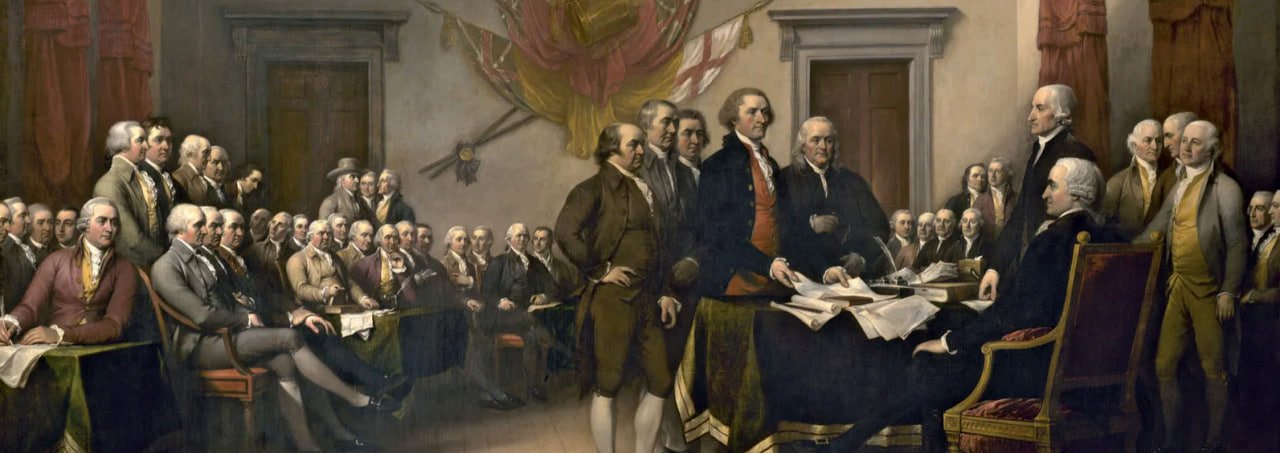
The Declaration of Independence asserted that legitimate government derives from the consent of the governed — and that a people has the right to resist tyranny. Ukraine's fight is, in essence, a 21st-century declaration of independence: a free people refusing subjugation, defending their right to choose their own alliances, their own faith, and their own future.
Hegemonic Stability Theory tells us that world order is not self-sustaining — it requires a leader willing to bear the costs of stewardship. History tells us that when America leads, freedom expands; when leadership falters, instability fills the vacuum. And the American experience itself tells us that the surest foundation of leadership is not power alone, but principle — institutions, alliances, and the moral confidence of a free people.
The greatest tribute Americans can offer the founders' legacy in this anniversary year is to reaffirm it: to ensure that support for Ukraine remains what it has always been at its strongest — bipartisan, principled, and durable. Support for Ukraine is not the property of any party. It belongs to the American tradition itself.
Happy 250th birthday, America.
The free world is proud to stand with you.
And grateful that you stand with Ukraine.