
BY VLADYSLAV FILATOV
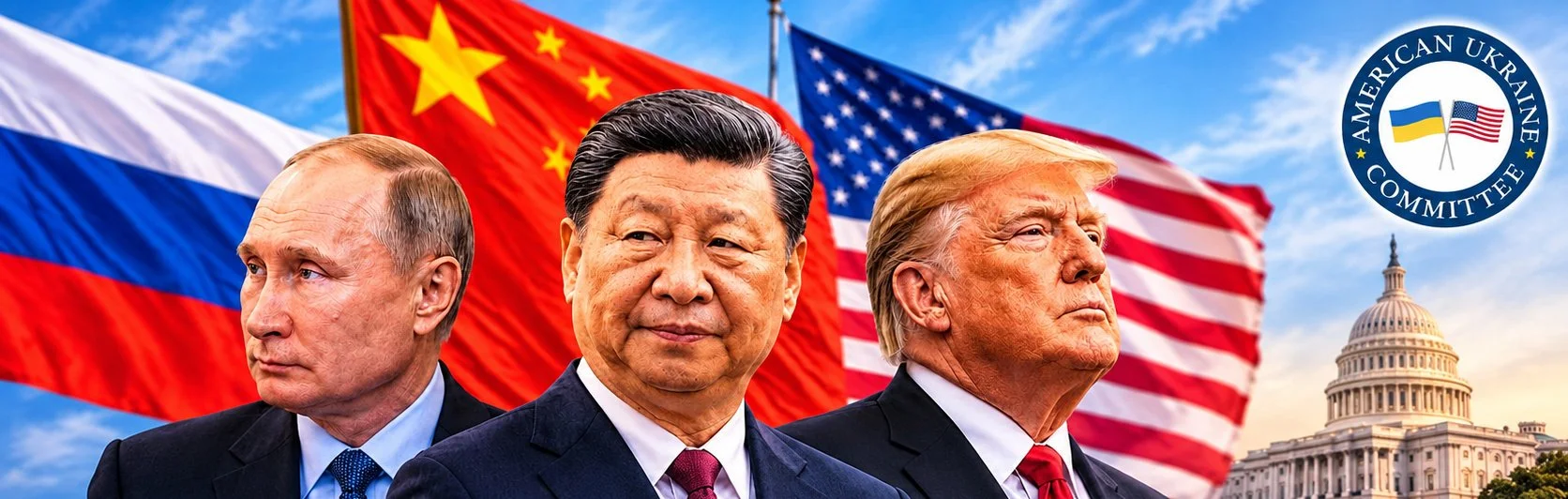
What The Upcoming Trump-Xi-Putin Meeting Could Mean For American Support For Ukraine?
On November 19, U.S. President Donald Trump, Chinese President Xi Jinping and Russian President Vladimir Putin are scheduled to meet in Shenzhen, China, on the sidelines of the Asia-Pacific Economic Cooperation (APEC) summit. It will be the first face-to-face trilateral meeting between the leaders of the three countries.
The meeting is attracting international attention, but its agenda remains only partly clear. Public statements have pointed to nuclear arms control and the situation in Iran as possible subjects. Ukraine is not expected to be a central focus of the discussions. At the same time, other public remarks have left open the possibility that the war could be mentioned. No formal agreement or concrete outcome concerning Ukraine has been announced in advance.
For American Ukraine Committee, the important question is not simply what the three leaders might say to one another. It is what, if anything, could follow from their discussions and how this might affect the relationship between the United States and Ukraine.
There Are Several Possible Scenarios Worth Considering
Scenario 1: Ukraine Is Not Discussed
The meeting could remain focused on nuclear security, Iran and relations between the three countries. In that case, there may be no immediate change in American policy toward Ukraine. Congressional work would continue through existing legislation, discussions about future security cooperation and oversight of policies already in place.
The absence of Ukraine from the meeting would not, by itself, determine the future of U.S. support. The more important indicators would be the decisions made in Washington after the summit.
Scenario 2: Ukraine Is Discussed, But No Concrete Initiative Follows
The leaders could exchange views on the war without announcing a joint position or proposing a specific diplomatic framework. This could generate considerable public attention, but a statement made during a meeting is not the same as a change in U.S. policy.
In this situation, Congress would remain an important institution to watch. Members could seek clarification on the administration's position, examine any subsequent policy announcements and continue their work on legislation, security assistance and sanctions.
Scenario 3: The Meeting Leads To A New Diplomatic Initiative
The most significant development would be the emergence of a concrete proposal or a commitment to further negotiations that could affect Ukraine. Such an initiative could raise practical questions about security arrangements, sanctions, weapons deliveries, reconstruction and the future of American assistance.
This is where Congress becomes particularly relevant. While the President leads diplomatic negotiations, Congress has constitutional responsibilities related to funding, legislation and oversight of foreign policy. It can examine proposed changes, consider their implications and shape the legal and financial framework of American engagement.
For the American-Ukraine relationship, this means that any diplomatic development should also be followed by looking at what happens on Capitol Hill.
Why Congress Remains Central
In the American Ukraine Committee we believe it is important not to measure the strength of the American-Ukraine relationship solely by meetings between presidents. Diplomatic engagement can create opportunities, but a lasting partnership also depends on institutional cooperation and decisions that continue beyond a single administration or summit.
Congress has a role in several areas that directly affect Ukraine: security assistance, weapons deliveries, sanctions enforcement, intelligence cooperation and long-term defense partnership. These are not abstract policy discussions. They involve legislation, funding decisions, implementation and accountability.
Whatever takes place in Shenzhen, the next steps in Washington will matter. We will be watching not only the statements coming out of the meeting, but also the legislative activity, congressional oversight and practical decisions that follow.
Ultimately, the most important measure will be what the United States does: the policies it maintains, the commitments it implements and the cooperation it continues to build with Ukraine. That is where the American-Ukraine relationship takes shape.
Every voice counts. Stay with us:
💬 Join our WhatsApp community
📩 Get updates from Capitol Hill
❤️ Help us keep the pressure on
