
Is Russia's Rassvet the Kremlin's Answer to Starlink?
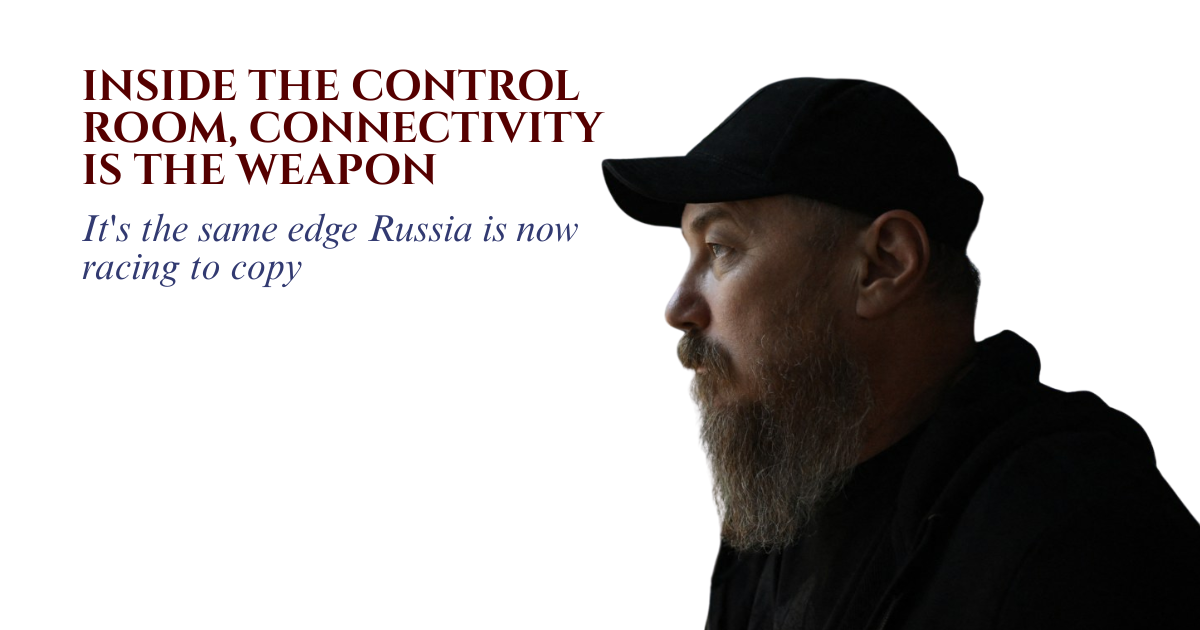
Ukraine's advantage in the drone war has never rested on hardware alone. It rests on connectivity, the invisible network that lets an operator hundreds of kilometers away guide a strike drone onto a moving target in real time.
In a rare interview, the commander of Ukraine's Unmanned Systems Forces,Maj. Robert “Magyar” Brovdi made that dependence explicit while describing the campaign to render occupied Crimea useless as a Russian staging ground. In the same conversation, he named a quieter, longer-term danger: Russia is building its own satellite network, Rassvet, to copy the very edge that has kept Ukraine a step ahead. This is the story of a race, and why its outcome may be decided less in orbit than in Congress.
The Connectivity That Wins the Drone War
Ukraine's summer offensive in Crimea has already disrupted rail bridges, fuel depots, and the power grid that feeds much of Russia's Soviet-era air defense. The commander described a deliberate, calibrated approach: different munitions for a bridge pier than for a fuel truck, an average of just three drones to destroy even a heavily defended target, but only where connectivity reaches.
Where the signal holds, precision follows.
Where it doesn't, the drones lose their eyes.
That is the quiet architecture behind the headlines. More than 300 Russian air defense assets destroyed in recent months, a shrinking number of missiles launched from the peninsula, an offensive that reportedly pushed Russian commands to relocate - all of it built on a communications backbone that Ukraine currently controls, and Russia does not.
The commander was blunt about the constraint that limits how far this can go: his forces are equipped at roughly 14% of what a full-scale Crimea campaign would require, and the bottleneck is not factory output, but the pace at which allied financing actually arrives.
Rassvet: Russia's Bid to Copy the Edge
The Kremlin has noticed the asymmetry, and it is spending to close it. Russia's answer is Rassvet — a low-Earth-orbit broadband constellation developed by Bureau 1440 and pitched as a domestic alternative to Starlink.
The system is designed to operate at roughly 800 kilometers altitude, with latency of up to 70 milliseconds and download speeds of up to 1 Gbps per user terminal, using laser links between satellites to move data directly in orbit.
The build-out is accelerating. A second batch of Rassvet satellites brought the constellation to roughly 40 orbiters, and Ukrainian military intelligence assesses the deployment is moving faster than originally planned.
Moscow's stated roadmap calls for 292 satellites by 2027 and 924 by 2035, backed by a state budget line and heavy private investment. For now the coverage is intermittent —the network can operate only when a satellite passes over Ukrainian territory, making Rassvet today a proof of concept rather than an operational rival. But the trajectory is the point.
Why This Is More Than a Connectivity Story
The stakes are not about broadband for Russian civilians. Reliable, low-latency satellite links are precisely what allow drones to be piloted in real time over long distances, let commanders share targeting data instantly, and keep strike operations running when terrestrial networks are jammed or destroyed.
In other words, Rassvet is a bid to give Russia the same persistent, resilient command-and-control that has made Ukraine's operators so effective, and to do it at a scale that could one day blanket the entire front.
Ukraine's own analysts have flagged the military applications directly: a completed Rassvet constellation could support Russian military communications, video transmission, drone control, and ground robotic systems.
Layer that onto the other threats the drone commander outlined: a concentration of harder-to-intercept jet-powered Shahed drones rising sharply, and Russian missile salvos he expects to grow from dozens toward 200 at a time, and the shape of the competition becomes clear. Russia is not trying to match Ukraine's ingenuity. It is trying to industrialize its way past it.
The Race Is Against the Clock
Here is the analytical core: Ukraine's edge is real but time-bounded. Every advantage described from the front - the Crimea window, the three-drones-per-target efficiency, the systematic blinding of Russian air defenses - depends on Ukraine moving faster than Russia can adapt. Rassvet is Russia's adaptation, and it is on a published schedule.
That reframes the commander's most important admission. When he says his forces operate at 14% capacity because financing "moves significantly slower than our plans," he is describing the one variable that both sides can influence: speed. Ukrainian production is not the constraint. The constraint is how quickly resources reach the front and how effectively pressure is kept on the machine funding Russia's side of the race. A delayed tranche does not just slow one offensive; it hands Moscow more of the one thing it needs most, time to finish its constellation.
The Lever That Sits in Washington
Rassvet, the missile salvos, the expanding drone fleets - all of it runs on money, and much of that money still flows from the same revenue streams sanctions were built to constrict. This is where the race in orbit connects to a very earthbound decision. Sustained, enforceable economic pressure slows the pace at which Russia can fund programs like Rassvet, while faster allied support lets Ukraine press its advantage before that window narrows. Speed on both fronts is the strategy.
That is the case for making sanctions mandatory rather than optional. Legislation that replaces discretionary language with firm obligations removes the delay and hesitation that give Russia room to catch up. Cutting the revenue is not a side issue to the drone war, it is one of the few levers that directly affects how much time Moscow has to close the gap.
Source: The Associated Press