
Peace Talks Need Leverage: S. 5025 Delivers It Before the August Recess
You already did this once. Doing it twice is what changes a schedule.
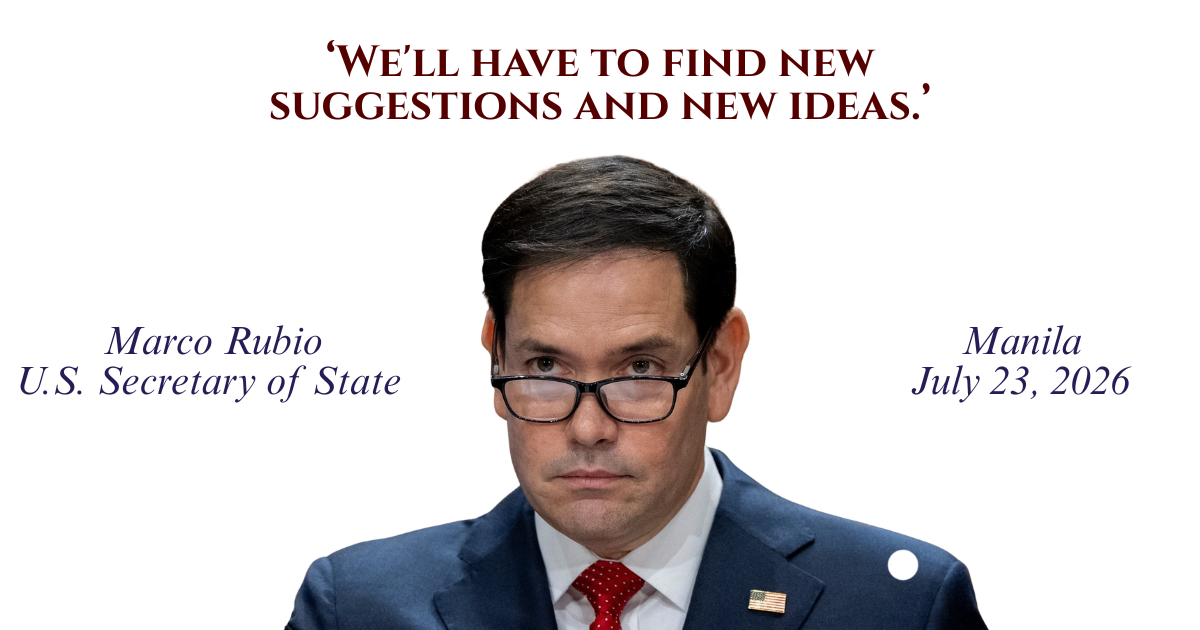
Speaking in Manila on July 23, U.S. Secretary of State Marco Rubio said the administration is prepared to help bring Russia's war against Ukraine to an end, while acknowledging that no quick path to a settlement exists. He described the war as a "senseless war," characterized previous rounds of U.S.-mediated diplomacy as "unsuccessful or at least unfruitful," and said Washington will need "new suggestions and new ideas" acceptable to both sides.
He also confirmed that there has been no change to American military support for Ukraine, with weapons purchased by NATO allies and transferred to Kyiv. That assessment is honest, and it points directly at a question Congress is now positioned to answer:
What, concretely, would give American diplomacy something new to work with?
Diplomacy Has Not Stalled for Lack of Effort
The Secretary's own account makes the point. Talks have been attempted repeatedly. The obstacle he identified is not the absence of American willingness, but the absence of an ending both sides can accept, and the reason for that gap is not a shortage of meetings. Moscow's posture at the same gathering illustrates it. Following his meeting with Rubio, Foreign Minister Sergey Lavrov's ministry emphasized what it called the unacceptability of continued arming of Ukraine and accused European states of pursuing Russia's strategic defeat, while restating a general readiness for a political resolution.
Read plainly: Russia's opening ask remains that Ukraine be disarmed, and its concession remains a willingness to keep talking. That is not a negotiating position that changes because a new meeting is scheduled. It changes when the cost of continuing the war exceeds the cost of ending it.
The "New Idea" Already Exists,
and It Has a Bill Number
The instrument the Secretary described as missing is already drafted, already filed, and already carries a supermajority. S. 5025, the Lindsey O. Graham Sanctioning Russia Act of 2026, was introduced on July 16 by Senators Richard Blumenthal (D-CT) and Darline Graham (R-SC), was referred to the Senate Banking, Housing, and Urban Affairs Committee, and launched with more than 60 bipartisan cosponsors.
With sixty-two cosponsors, the bill has already cleared a filibuster-proof threshold, and scheduling a floor vote now rests with Senate Majority Leader John Thune — who is himself among the legislation's cosponsors. The White House provided its support for the measure in writing. In other words, the leverage American negotiators need is not a hypothetical requiring months of drafting. It is a text that has cleared negotiation between the Senate and the executive branch and is waiting on floor time.
What the Legislation Actually Does
S. 5025 is built to reach the revenue that sustains the war rather than to make a symbolic statement. It imposes primary and secondary sanctions on Russian officials, oligarchs and their family members, foreign persons, Russian banks and financial institutions, and the Russian shadow fleet.
It authorizes tariffs of up to 100 percent on the top five purchasers of Russian crude oil and natural gas, and on the top five countries facilitating Russian sanctions evasion, with a carve-out for states importing less than 15 percent of Russia's natural gas exports that are taking significant steps to reduce those imports.
It bars U.S. persons from purchasing Russian sovereign debt, from making new investments in Russia or its energy sector, and from transferring funds to or for the benefit of Russian officials. It preserves a presidential waiver conditioned on a national-interest certification to Congress, consistent with other sanctions statutes. That last provision matters for the diplomatic argument. The bill does not tie the administration's hands at the negotiating table; it hands the administration a lever it can hold, tighten, or, with justification to Congress, release. That is precisely the structure a negotiator wants.
The Legacy Question Is Also a Practical One
Senator Lindsey Graham met with President Volodymyr Zelenskyy to discuss this effort and secured an agreement with the White House on the Friday before his death.
Senator Darline Graham, appointed to succeed her brother, has said that passing the legislation would honor his commitment to national security and give the President additional leverage to bring the war to an end.
The Calendar Is the Constraint
The Secretary of State says Washington is ready to act if conditions change. Conditions do not change on their own. The Senate has a filibuster-proof cosponsor list, a committee referral, and written White House support. What it does not yet have is floor time, and the August recess is approaching. Every week without a vote is a week in which the Kremlin's oil and gas revenue flows uninterrupted, and a week in which American diplomats sit down without the one argument that has historically moved Moscow.
Two minutes today. One vote closer before August.