
Why Are Strikes on Russia's Petrochemical Plants Crippling Its Weapons?
Take Action Now
When Ukrainian forces hit a Russian oil refinery, the headlines tend to focus on fuel shortages and lost export revenue. A newer pattern of strikes is aimed at a very different kind of target, and it reaches far deeper into Russia's ability to actually manufacture weapons.
On August 10, a fire tore through ZapSibNeftekhim in Tobolsk, more than 2,000 kilometers from Ukraine and one of the largest petrochemical complexes in the country. As reported by Ukrainska Pravda, the operation was carried out by Special Operations Forces units alongside a resistance movement operating inside Russia. Because the plant's output feeds Russia's defense-industrial sector, it stood as a legitimate military target.
The difference between a refinery and a petrochemical plant matters far more than it might appear. Here is why these strikes are landing exactly where they hurt most.
Petrochemicals Sit at the Very Start of the Weapons Chain
A refinery makes fuel. A petrochemical complex makes the raw materials that go on to become weapons. According to aviation expert Anatoliy Khrapchynskyi, cited by Ukrainska Pravda, the Tobolsk complex supplies the primary feedstock used to produce the specialized components behind Russia's munitions and missile programs.
That feedstock reportedly turns up across Russia's arsenal: as a base for solid rocket propellant in Iskander-M ballistic missiles, in S-300 and S-400 air-defense missiles, and in rockets for Grad, Uragan, and Smerch systems.
It is also a starting material for large-caliber artillery powders, for the plastic explosives used in shaped charges and mines, and for the warheads of attack drones. A second major use is materials for military hardware itself — the specialized plastics molded into the bodies and wings of Shahed-type and loitering munitions, the fibers used in body armor, wiring insulation, and the synthetic rubber required for heavy military tires and fuel tanks.
In other words, a single complex like Tobolsk sits upstream of dozens of weapons at once. Damage it, and the effect eventually flows downstream into all of them.
The Damage Is Real
Russia halted operations at the plant immediately, and the first consequences surfaced within a day. Liquefied gas normally shipped from Tobolsk stopped appearing on Russia's commodity exchange, cutting off a flow that typically ran to several thousand metric tons a day.
But no one should expect an instant effect on the front line. Because petrochemicals sit at the very beginning of the production chain, Russia can draw on operational reserves for a time. As Khrapchynskyi explained, the real squeeze is a cascading one: buffer stocks buy roughly one and a half to three months before a genuine feedstock shortage sets in, at which point the defense industry begins to feel systemic strain and delays in delivering new munitions and equipment. The pain is delayed, but it compounds.
Some Targets Have No Substitute
Anywhere on Earth
A related strike on August 13 hit the Gazprom Neftekhim Salavat facility, which energy and security expert Mykhailo Honchar described to Ukrainska Pravda as genuinely one of a kind. It reportedly produces heptyl — a high-energy liquid propellant used in intercontinental ballistic missiles with liquid engines, and, according to Honchar, made nowhere else in Russia.
While the ballistic missiles striking Ukraine largely use solid fuel, heptyl remains essential to Russia's strategic ICBM program and its regular test launches. Crucially, it is a Soviet-era formulation that no other country produces or could hand over. The same is true of certain specialized lubricants engineered for particular systems — Western equivalents exist, but they, too, are going to be hard to obtain under sanctions. When a target has no global replacement, a single successful strike carries outsized strategic weight.
Why This Is Not the Same as Hitting a Refinery
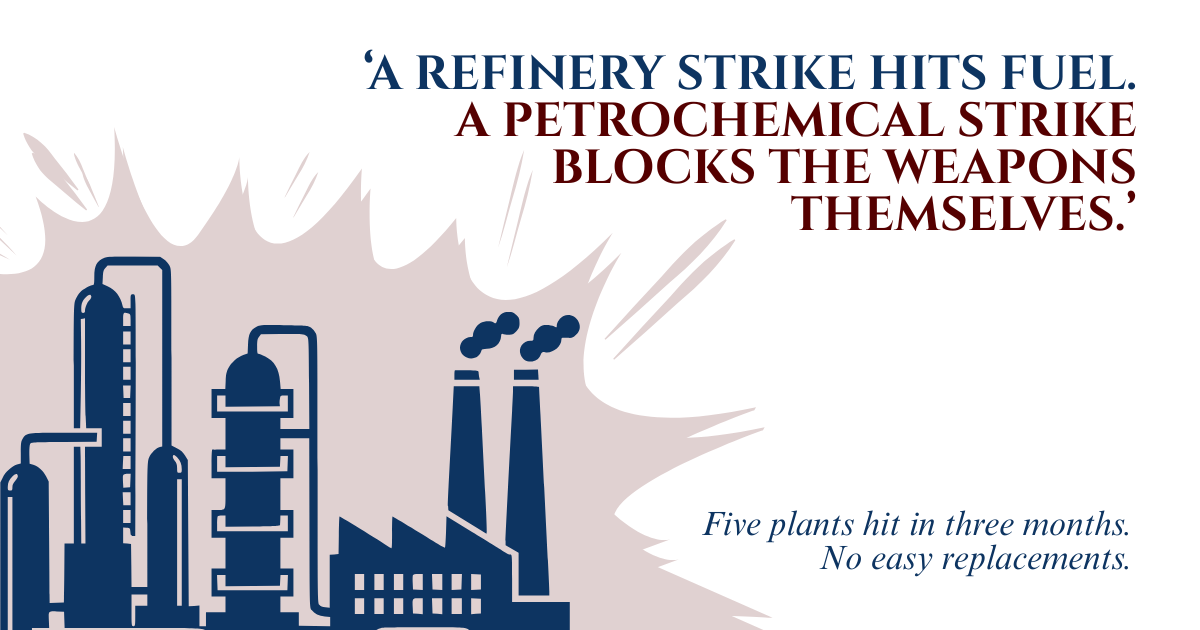
Honchar drew a sharp line between the two kinds of targets. A strike on a classic refinery hits fuel, the diesel and gasoline that keep frontline vehicles moving. A strike on petrochemicals blocks the manufacture of weapons themselves. And the two are not equally recoverable: a damaged refinery can often be offset by a neighboring one, but the petrochemical giants are few, and their equipment is far more complex and sensitive. There is no easy backup.
Act For Ukraine
Source: Ukrainska Pravda (pravda.com.ua)