
How NOT to Build Ukrainian Political Strength: Bad Lessons Taught by a PoliSci Professor
There was a tweet circulating on X in the aftermath of the vote in favor of the Ukraine Support Act, which got some press on Ukraine chats. It read in full
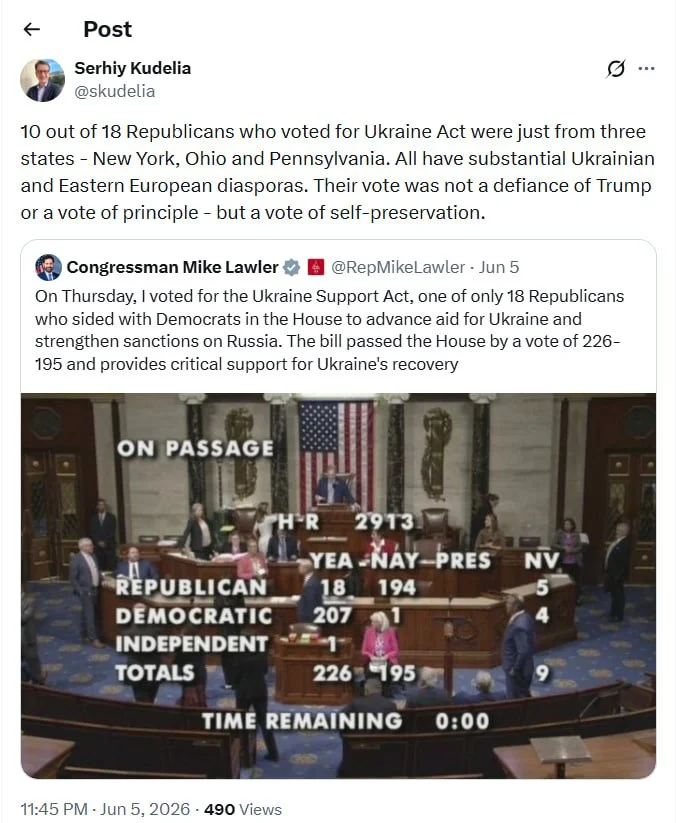
“10 out of 18 Republicans who voted for the Ukraine Act were just from three states - New York, Ohio, and Pennsylvania. All have substantial Ukrainian and Eastern European diasporas.
Their vote was not a defiance of Trump or a vote of principle - but a vote of self-preservation.”
Considering it was written by a professor of PoliSci, the author seems not to get politics particularly well.
What is the problem?
First, Representatives are elected by voters in a particular district, not by the State as a whole. So, even if Ohio, Pennsylvania, and New York all have a lot of Ukrainians, it does not follow that the Republicans have a lot of Ukrainians in their particular district.
In fact, Reps. Miller (OH-7), Thompson (PA-15), and Carey (OH-15) all have fewer Ukrainians than the national average in their districts. Outside of those 3 States, 5 of the Republican Reps who voted in favor have less than 0.1% of Ukrainians in their district, but still supported the Bill. (Kiggans, Murphy, Giminez, Wilson, and McCaul).
In fact, only 1 of the 18 Republicans represents a district with more than 1% Ukrainian population (Fitzpatrick). Nor really enough to make it an issue of self-preservation at the ballot box.
If you wanted to find a common theme among the supportive Republicans, don’t look to the number of Ukrainians in the district, but instead to the Committees these Republicans serve and the Caucuses they belong to.
Almost all of these Republicans belong to the Republican Main Street Caucus or the Problem Solvers Caucus. Additionally, a sizable group of them serve on the House Armed Services Committee, the House Foreign Affairs Committee, Appropriations, or Intelligence: a total of 15, including several Chairs.
The Democrats and the Republicans are the two major political parties in the US. (ABC News)
Most importantly, following the advice of this PoliSci professor gives the Ukrainian community the exactly wrong advice as to how to build political power by implying that the community alone (or at best with other Eastern European communities) can win or lose elections and thus, influence results in Congress.
In fact, America is too big for almost any group to force policy based on numbers. All the more so for Ukrainians who represent only 0.4% of American voters.
Even worse for getting policy passed, the Ukrainian population is concentrated, as the Professor noted. In contrast, political power in America is dispersed – Speaker of the House is from Louisiana, Head of Senate from South Dakota, Head of Senate Armed Services from Mississipi and House Armed Services from Florida. None of the regions has a lot of Ukrainians, and all needed to pass pro-Ukraine legislation.
What should we do instead?
Instead of focusing on trying to “win” elections, an impossible task with Ukrainians totaling only 0.4% of American voters, supporters of the American-Ukraine relationship should focus on building relationships after elections: both with Congressmen and political factions, not just ethnic groups.
American Ukraine Committee understands that dynamic. Its outreach is to incumbents in Congress, not to challengers collecting money to unseat a sitting Congressman who may or may not support Ukraine.
AmUkr works with Congressmen on both sides of the aisle and focuses on issues that unite Americans:
strong defense and European security;
protecting worshippers from religious persecution at the hands of Russian invaders;
cooperation between Ukraine Military tech and the US military to ensure innovation is incorporated into US defense to keep all Americans safe;
Ukraine supporters should celebrate the passage of the Ukraine Support Act and the bipartisan majority in Congress that backed the bill. In order to see additional legislation pass, we need to focus on building relations with all Members of Congress, not believe in the false hope that Ukrainian votes are going to swing the tide of any particular races.