
What If Russia Paid for the Missiles That Stop Its Own Attacks?
Today, President Volodymyr Zelenskyy warned that Ukraine's intelligence shows Russia preparing another massive strike. He urged citizens to take air raid alerts seriously and asked partners for more air defense.
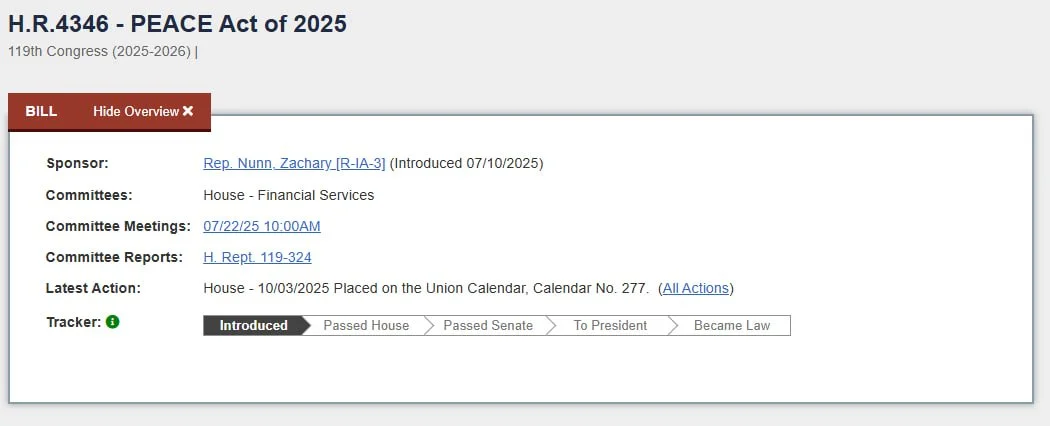
Meanwhile, billions of dollars in Russian sovereign assets sit immobilized in U.S. financial institutions. A bill that would put those funds to work for Ukraine's defense has been waiting for a House floor vote for more than a year. That bill is H.R. 4346, the Preventing the Escalation of Armed Conflict in Europe (PEACE) Act.
What Ukraine Is Facing Tonight
Russia's large combined attacks follow a familiar pattern: waves of drones and missiles aimed at cities and energy infrastructure, usually at night. Every attack Ukraine stops costs interceptors, and every one it cannot stop costs lives, homes, and power for millions of people. With winter coming, protecting the energy grid becomes a matter of survival. Ukraine's need for air defense is not abstract. It is measured in hours.
What the PEACE Act Does
H.R. 4346 is a bipartisan bill introduced by Rep. Zach Nunn (R-IA) with Rep. Josh Gottheimer (D-NJ) as lead cosponsor. Its key provisions:
Russian sovereign assets go to Ukraine. The Treasury Secretary would seize assets of the Central Bank of Russia, the National Wealth Fund, and the Russian Ministry of Finance held by U.S. financial institutions and deposit them into a Ukraine Support Fund for defense and humanitarian assistance.
Pressure on the banks behind Russia's war economy. Foreign financial institutions that provide significant services to sanctioned Russian entities or to Russia's energy sector could lose or face strict limits on access to the U.S. financial system.
A focus on energy giants. Treasury would be required to determine whether Gazprom, Rosneft and Lukoil operate in Russia's energy sector.
Built-in accountability. The bill allows only a narrow presidential waiver and ends after a sustained Russian ceasefire, which keeps the incentive clear: stop the war, and the pressure ends.
The House Financial Services Committee approved the bill 53-1 on July 22, 2025. Votes that lopsided are rare in today's Congress.
A Former Treasury Official Makes the Case
On September 29, The Wall Street Journal published a letter from Gregory P. Wilson, Deputy Assistant Secretary of the Treasury from 1986 to 1989, titled "A Welcome for Russia, a Choice for Congress." Responding to the planned invitation for Vladimir Putin to attend the G20 Summit in December, Wilson argues that the United States should be working with its allies "to project strength to counter Russia's increasing threats" against European nations.
His conclusion is direct: Congress should pass the PEACE Act so that Ukraine can use immobilized Russian funds "to buy defensive weapons it desperately needs, no U.S. taxpayer funds required." In his view, this is how Congress can ensure that the United States "acts from a position of strength, not from a position of weakness."
When someone who served in the Treasury Department makes this argument, it carries weight. The legal and financial tools already exist. What is missing is the decision to use them.
The Financial Logic:
Russia Pays for the Damage It Causes
The PEACE Act is a rare policy that combines strategic, moral, and fiscal sense:
No cost to American taxpayers. The money is Russia's own.
Direct accountability. The country that destroys Ukrainian power plants and apartment blocks pays for the systems that protect them.
A signal to Moscow. Each month these assets sit idle, the Kremlin is reminded that waiting can still pay off. Transferring them sends the opposite message: the cost of aggression only goes up.
Timing Is Everything
Last month, Congress took a historic step when the Sanctioning Russia and Iran Act became law. The PEACE Act is the logical next step. Sanctions limit how much money Russia can earn from its war. The PEACE Act turns Russia's own money into protection for the people it attacks.
Timing matters. Congress returns after the November elections, while Russia keeps stockpiling missiles and drones for the winter campaign against Ukraine's energy system. Every week of delay means fewer interceptors on the ground when the next wave comes.
The question is no longer whether these assets should help Ukraine. A 53-1 committee vote has already answered that. The question is whether Congress will act before the next massive strike or after it.
Every voice counts. Stay with us:
💬 Join our WhatsApp community
📩 Get updates from Capitol Hill
❤️ Help us keep the pressure on
Source: Gregory P. Wilson, "A Welcome for Russia, a Choice for Congress," The Wall Street Journal, September 29, 2026
Bill text and actions: H.R. 4346 on Congress.gov